Other grades of this product :
| Tebufenpyrad Basic information |
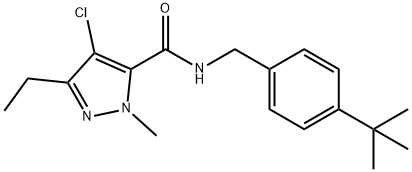
| Product Name: | Tebufenpyrad | | Synonyms: | TEBUFENPYRAD;PYRANICA;OSCAR;1h-pyrazole-5-carboxamide,4-chloro-n-((4-(1,1-dimethylethyl)phenyl)methyl)-3-e;4-chloro-n-((4-(1,1-dimethylethyl)phenyl)methyl)-3-ethyl-1-methyl-1h-pyrazol;4-chloro-n-((4-(1,1-dimethylethyl)phenyl)methyl)-3-ethyl-1-methyl-1h-pyrazole-5-carboxamid;ac801757;comanché | | CAS: | 119168-77-3 | | MF: | C18H24ClN3O | | MW: | 333.86 | | EINECS: | 242-070-7 | | Product Categories: | Agro-Products;Aromatics;Herbicide;INSECTICIDE;Heterocycles | | Mol File: | 119168-77-3.mol |
| Tebufenpyrad Chemical Properties |
| Hazard Codes | Xn | | Risk Statements | 22 | | Safety Statements | 36 | | RIDADR | 2588 | | WGK Germany | 3 | | RTECS | UQ6276400 | | HazardClass | 6.1(b) | | PackingGroup | III | | HS Code | 29331990 | | Hazardous Substances Data | 119168-77-3(Hazardous Substances Data) | | Toxicity | LD50 in male, female rats (mg/kg): 595, 997 orally; >2000, >2000 dermally; LC50 in male rats (mg/m3): 2660 by inhalation (Inoue, Fukuchi) |
| Tebufenpyrad Usage And Synthesis |
| Chemical Properties | Tan Solid | | Uses | Tebufenpyrad is a pyrazole acaricide and insecticide commonly used in commercial greenhouses. | | Uses | Acaricide. | | Metabolic pathway | By incubation of tebufenpyrad with rat liver
homogenate, tebufenpyrad undergoes
biotransformation to yield the major metabolites N-(4-
tert-butylbenzyl)-4-chloro-3-(1-hydroxyethyl)-1-
methylpyrazole-5-carboxamide via hydroxylation of the
w-1-carbon of the ethyl group and N-[4-(1-carboxy-1-
methylethyl)benzyl]-4-chloro-3-ethyl-1-methylpyrazole-
5-carboxamide via oxidation of the methyl group in the
tert-butyl moiety to the carboxylic acid derivatives.When the rat is orally dosed tebufenpyrad, the major
metabolism pathway is via both hydroxylation and
oxidation reactions to yield N-[4-(1-carboxy-1-
methylethyl)benzyl]-4-chloro-3-(1-hydroxyethyl)-1-
methylpyrazole-5-carboxamide which is mainly
excreted in the urine. |
| Tebufenpyrad Preparation Products And Raw materials |
|


 日本语
日本语 한국어
한국어 Français
 Deutsch
 España
 Türkiye