| Chemical Properties | colourless crystals or white powder |
| Chemical Properties | Maltose occurs as white crystals or as a crystalline powder. It is
odorless and has a sweet taste approximately 30% that of sucrose. |
| Originator | Maltos-10 ,Otsuka ,Japan ,1974 |
| Occurrence | Maltose also is formed by yeast during breadmaking. |
| Uses | Maltose is used as a nutrient, sweetener, and culture medium. |
| Uses | Maltose is a sweetener formed by the enzymatic action of yeast on
starch. it consists of two dextrose molecules. maltose dissolves and
crystallizes slowly in aqueous solutions, and is less sweet and more
stable than sucrose. it is used in combination with dextrose in bread
and in instant foods, and is also used in pancake syrups. |
| Uses | Nutrient, sweetener, culture media, stabilizer
for polysulfides, brewing. |
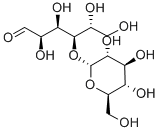
| Definition | The most common reducing disaccharide, composed of two molecules of glucose. Found in starch and glycogen. |
| Production Methods | Maltose monohydrate is prepared by the enzymatic degradation of
starch. |
| Definition | A sugar
found in germinating cereal seeds. It is a
disaccharide composed of two glucose
units. Maltose is an important intermediate
in the enzyme hydrolysis of starch. It is
further hydrolyzed to glucose. |
| Manufacturing Process | The process of manufacturing a maltose product from a suitably purified starch source includes preparing an aqueous starchy suspension, adjusting the acidity thereof to from 4.6 to 6.0 pH, liquefying the suspension by heating in the presence of a diastatic agent, diastatically saccharifying the liquefied mixture, filtering, and concentrating the liquid to a syrup. |
| Therapeutic Function | Sugar supplement |
| Pharmaceutical Applications | Maltose is a disaccharide carbohydrate widely used in foods and
pharmaceuticals. In parenteral products, maltose may be used as a
source of sugar, particularly for diabetic patients.
Crystalline maltose is used as a direct-compression tablet
excipient in chewable and nonchewable tablets. |
| Safety Profile | Experimental
teratogenic and reproductive effects.
Questionable carcinogen with experimental
tumorigenic data. When heated to
decomposition it emits acrid smoke and
irritating fumes. |
| Safety | Maltose is used in oral and parenteral pharmaceutical formulations
and is generally regarded as an essentially nontoxic and nonirritant
material. However, there has been a single report of a liver
transplantation patient with renal failure who developed hyponatremia
following intravenous infusion of normal immunoglobulin
in 10% maltose. The effect, which recurred on each of four
successive infusions, resembled that of hyperglycemia and was
thought to be due to accumulation of maltose and other osmotically
active metabolites in the extracellular fluid.
LD50 (mouse, IV): 26.8 g/kg
LD50 (mouse, SC): 38.6 g/kg
LD50 (rabbit, IV): 25.2 g/kg
LD50 (rat, IP): 30.6 g/kg
LD50 (rat, IV): 15.3 g/kg
LD50 (rat, oral): 34.8 g/kg |
| storage | Maltose should be stored in a well-closed container in a cool, dry
place. |
| Incompatibilities | Maltose may react with oxidizing agents. A Maillard-type reaction
may occur between maltose and compounds with a primary amine
group, e.g. glycine, to form brown-colored products. |
| Regulatory Status | In the USA, maltose is considered as a food by the FDA and is
therefore not subject to food additive and GRAS regulations.
Included in the FDA Inactive Ingredients Database (oral solutions).
Included in the Canadian List of Acceptable Non-medicinal
Ingredients. Included in parenteral products available in a number
of countries worldwide. |


 日本语
日本语 한국어
한국어 Français
 Deutsch
 España
 Türkiye