Other grades of this product :
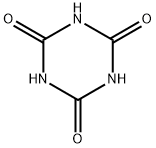
| Product Name: | Cyanuric acid | | Synonyms: | 2,4,6-Triazinetrione;2,4,6-Trihydroxytriazine;1,3,5-triazine-2,4,6(1h,3h,5h)-trione;-Azabarbituric acid;cp4789;Cyanuric acid, anhydride;cyanuricacid(non-specificname);Cyanursαure | | CAS: | 108-80-5 | | MF: | C3H3N3O3 | | MW: | 129.07 | | EINECS: | 203-618-0 | | Product Categories: | water treatment;INORGANIC & ORGANIC CHEMICALS;Aromatics;Heterocycles;108-80-5 | | Mol File: | 108-80-5.mol |
| Cyanuric acid Chemical Properties |
| Melting point | 360 °C | | Boiling point | 74 °C | | density | 1.56 | | vapor pressure | <0.0001 Pa (25 °C) | | refractive index | 1.4500 (estimate) | | storage temp. | Store below +30°C. | | solubility | Soluble in sulfuric acid, dimethylformamide, sodium hydroxide, potassium hydroxide and diemthyl sulfoxide. Slightly soluble in acetone, benzene, diethyl ether, ethanol and hexane. Insoluble in cold methanol, benzene and chloroform. | | form | Crystalline Powder or Lumps | | pka | 6.88, 11.40, 13.5(at 25℃) | | color | White to light beige | | PH | 3.8-4.0 (H2O, 20℃)(saturated solution) | | Water Solubility | 0.3 g/100mL (25 ºC) | | Merck | 14,2698 | | BRN | 126982 | | Stability: | Stable. Incompatible with strong oxidizing agents. | | InChIKey | ZFSLODLOARCGLH-UHFFFAOYSA-N | | LogP | -1.31 at 25℃ | | CAS DataBase Reference | 108-80-5(CAS DataBase Reference) | | NIST Chemistry Reference | 1,3,5-Triazine-2,4,6(1H,3H,5H)-trione(108-80-5) | | EPA Substance Registry System | Cyanuric acid (108-80-5) |
| Cyanuric acid Usage And Synthesis |
| Uses | 1.Used as ultraviolet absorbent for plastic film.
2.Used as chemical reagent, also used in organic synthesis.
3.Mainly used in the production of new bleaching agent, disinfectant, water treatment agent and resin, paint and metal cyanide corrosion inhibitor, etc.
4.Used for the synthesis of chloro derivatives, trichloroisocyanuric acid, dichloro isocyano uric acid sodium or potassium; used for synthesizing cyanuric acid-formaldehyde resin, epoxy resin, antioxidant, coatings, adhesives, pesticides, herbicides, metal cyanide inhibitor and polymer modifier; used in the manufacture of halotrizinol.
| | Methods of production | It is obtained by the polymerization of urea. Mixed urea and ammonium chloride, heating and melting, stirring and temperature to 210℃, solution thickened, warming up to 230℃, melting gradually solidified, stir fry evenly, continue to heat up to 250℃, thermal insulation for 15 min, cold to 100℃, adding a small amount of water immersion and down to room temperature in water soaking crushed, filtered solids. The water and hydrochloric acid are added into the solid, stirring and heating to 110 ℃, insulation for 3 h, supplementing with hydrochloric acid and water, cooling to 30 ℃, and washing to neutral, filter, filter cake with water washing and drying to obtain the product. The product purity is ≥95%, consumption of urea 1200kg per ton of product.
| | Chemical Properties | white powder | | Uses | Diagnostic determination of Melamine and related compounds in kidney tissue. | | Uses | Convenient lab source of cyanic acid gas. In preparation of melamine, sponge rubber, herbicides, dyes, resin, antimicrobial agents. As stabilizer and disinfectant in swimming pool water. | | Uses | Cyanuric acid is used in chemical synthesis (see Section
31.0), as an intermediate for chlorinated bleaches, as a
selective herbicide, and as a whitening agent. The parent
compound and salts, chlorinated salts, and chlorinated acids
are used to disinfect swimming pools, restaurants, and barns.
Chlorinated salts hydrolyze in water to form cyanurate and
hypochlorous acid. Other monomeric isocyanurates (e.g.,
triallyl cyanurate) are used as cross-linking components for
producing polyurethanes, polyesters, and alkyd resins. Tris
(2-hydroxyethyl)isocyanurate is used in wire lacquers.
Cyanuric acid is produced in the United States. | | Definition | cyanuric acid: A white crystallinewater-soluble trimer of cyanic acid,(HNCO)3. It is a cyclic compound havinga six-membered ring made of alternatingimide (NH) and carbonyl(CO) groups (i.e. three -NH-C(O)-units). It can also exist in a phenolicform (three -N=C(OH)- units). | | Production Methods | Cyanuric acid is an odorless, crystalline powder. Chlorinated
isocyanuratesareusuallypreparedbycontrolledchlorinationof
the sodium or potassium salts of cyanuric acid. Other monomeric
isocyanurates made from the parent compound include
tris(2-hydroxyethyl)isocyanurate and triallyl cyanurate. | | Definition | ChEBI: The keto tautomer of cyanuric acid. | | General Description | Crystals. | | Air & Water Reactions | Soluble in hot water [Hawley]. | | Reactivity Profile | An amide and amine. Organic amides/imides react with azo and diazo compounds to generate toxic gases. Flammable gases are formed by the reaction of organic amides/imides with strong reducing agents. Amides are very weak bases (weaker than water). Imides are less basic yet and in fact react with strong bases to form salts. That is, they can react as acids. Mixing amides with dehydrating agents such as P2O5 or SOCl2 generates the corresponding nitrile. The combustion of these compounds generate mixed oxides of nitrogen (NOx) | | Flammability and Explosibility | Notclassified | | Purification Methods | It crystallises from water. Dry it at room temperature in a desiccator in a vacuum. [Beilstein 26 III/IV 632.] |
| Cyanuric acid Preparation Products And Raw materials |
| Raw materials | Sulfuric acid-->Ammonium chloride-->Urea-->2,4,6-tris(phenylsulfanyl)-1,3,5-triazine-->Methyl benzenesulfonate | | Preparation Products | Chloroacetone-->Metribuzin-->Sodium dichloroisocyanurate-->Trichloroisocyanuric acid-->Antioxidant3114-->1,3,5-Tris(2-hydroxyethyl)cyanuric acid-->1,3,5-Triglycidyl isocyanurate-->DICHLOROISOCYANURIC ACID-->TYCOR (TM)-->1,3-Dichloro-1,3,5-triazinetrione,sodium salt-->1,3,5-Tri-2-propenyl-1,3,5-triazine-2,4,6(1H,3H,5H)-trione-->DIBROMOISOCYANURIC ACID-->Melamine cyanurate-->2,4,6-TRINITROANILINE-->cyanic acid |
|


 日本语
日本语 한국어
한국어 Français
 Deutsch
 España
 Türkiye