Other grades of this product :
| D-Aspartic acid Basic information |
| D-Aspartic acid Chemical Properties |
| Melting point | >300 °C(lit.) | | alpha | -25.8 º (c=5, 5N HCl) | | Boiling point | 245.59°C (rough estimate) | | density | 1.66 | | refractive index | -25 ° (C=8, 50% HCl) | | storage temp. | Keep in dark place,Inert atmosphere,Room temperature | | solubility | Aqueous Acid (Sparingly) | | pka | pK1: 1.89(0);pK2: 3.65;pK3: 9.60 (25°C) | | form | Crystalline Powder | | color | White to off-white | | optical activity | [α]20/D 24°, c = 2.3 in 6 M HCl | | Water Solubility | SOLUBLE | | Merck | 14,840 | | BRN | 1723529 | | InChIKey | CKLJMWTZIZZHCS-UWTATZPHSA-N | | CAS DataBase Reference | 1783-96-6(CAS DataBase Reference) | | NIST Chemistry Reference | D-aspartic acid(1783-96-6) |
| D-Aspartic acid Usage And Synthesis |
| Chemical Properties | White or almost white crystalline powder | | Uses | A non-essential amino acid found in food sources and dietary supplements. D-Aspartic acid's conjugate base D-aspartate has potential use as a a therapeutic agent in the treatment of schizophrenia-related symptoms.
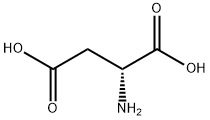
| | Uses | D-Aspartic acid modulates melatonin synthesis in the pineal gland. | | Definition | ChEBI: The D-enantiomer of aspartic acid. | | Biological Activity | Endogenous NMDA receptor agonist with similar activity to the L-isomer (L-Aminosuccinic acid ). Also a non-metabolizable substrate for EAA uptake systems. Modulates melatonin synthesis in the pineal gland. |
| D-Aspartic acid Preparation Products And Raw materials |
|


 日本语
日本语 한국어
한국어 Français
 Deutsch
 España
 Türkiye