Other grades of this product :
| Diisooctyl phthalate Basic information |
| Diisooctyl phthalate Chemical Properties |
| Diisooctyl phthalate Usage And Synthesis |
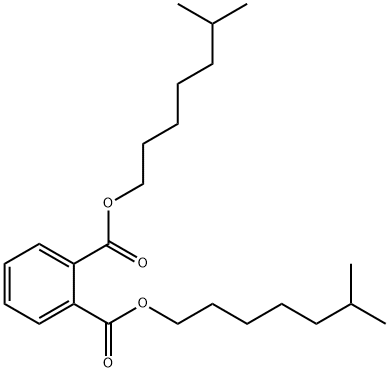
| Chemical Properties | The empirical formula of diisooctyl phthalate (DIOP) is
C24H38O4. The structural formula of DIOP varies because
the iso-alcohols used in the manufacture contain several
isomers. DIOP is insoluble in water, but
it is soluble in organic solvents. | | Uses | Its major
use is as a plasticizer. | | Uses | Diisooctyl Phthalate can be used as a plasticizer. | | Production Methods | DIOP is manufactured by the reaction of phthalic anhydride
with isooctanol in the presence of an acid catalyst. | | General Description | Oily colorless liquid with a slight ester odor. Denser than water. Insoluble in water. | | Air & Water Reactions | Insoluble in water. | | Reactivity Profile | Diisooctyl phthalate reacts exothermically with acids to generate isooctyl alcohol and phthalic acid. Strong oxidizing acids may cause a vigorous reaction that is sufficiently exothermic to ignite the reaction products. Heat is also generated by interaction with caustic solutions. Flammable hydrogen is generated by mixing with alkali metals and hydrides. Can generate electrostatic charges. [Handling Chemicals Safely, 1980. p. 250]. | | Health Hazard | Produces no ill effects at normal temperatures but may give off irritating vapor at high temperature. | | Fire Hazard | Special Hazards of Combustion Products: None |
| Diisooctyl phthalate Preparation Products And Raw materials |
|


 日本语
日本语 한국어
한국어 Français
 Deutsch
 España
 Türkiye