Other grades of this product :
| Sodium lauroylsarcosinate Chemical Properties |
| Melting point | 46 °C | | density | 1.033 g/mL at 20 °C | | vapor pressure | 0.02 hPa (20 °C) | | RTECS | MC0598960 | | Fp | 267℃ | | storage temp. | room temp | | solubility | H2O: 1 M at 20 °C, clear, colorless | | form | Powder | | Specific Gravity | 1.03 (20/4℃) | | color | White | | PH | 7.0-9.0 (25℃, 1M in H2O) | | Water Solubility | Soluble in water (293 g/L). | | Sensitive | Hygroscopic | | λmax | λ: 260 nm Amax: 0.2λ: 280 nm Amax: 0.06 | | Merck | 14,4368 | | BRN | 5322974 | | Stability: | Stable. Incompatible with strong oxidizing agents. | | LogP | 0.37 | | CAS DataBase Reference | 137-16-6(CAS DataBase Reference) | | EPA Substance Registry System | Sodium N-lauroylsarcosinate (137-16-6) |
| Sodium lauroylsarcosinate Usage And Synthesis |
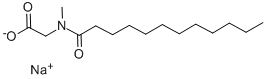
| Uses | Sodium lauroyl sarcosinate (INCI), also known as sarkosyl, is a white powder derived from sarcosine, which make it is fate-free and biodegradable. The surfactant is amphiphilic due to the hydrophobic 12-carbon chain (lauroyl) and the hydrophilic carboxylate.
Sodium lauroyl sarcosinate is personal care products as well as in household and industrial applications, and it is used as a co-surfactant in cleanser formulations such as shampoos and body washes. It can also be used in oral care applications such as toothpastes and incorporated into syndet and combo bars. The typical usage levels range from 1-5% on an active basis.
| | Application | Sodium lauroyl sarcosinate (INCI) is mild, biodegradable anionic surfactants derived from sarcosine used as a foaming and cleansing agent in shampoo, shaving foam, toothpaste, and foam wash products. The surfactant is amphiphilic due to the hydrophobic 12-carbon chain (lauroyl) and the hydrophilic carboxylate.
Sodium lauroyl sarcosinate is a high foam, eco-friendly surfactant. It has good chlorine stability with anti-corrosion properties. This surfactant has excellent ocular tolerance and gentleness. Sodium lauroyl sarcosinate is often seen in shampoos, bath, cleansing and shaving products as a foaming agent, surfactant, and hair conditioning agent. Sodium lauroyl sarcosinate has the ability to enhance the appearance and feel of hair by improving body, suppleness and sheen, especially in hair that is chemically damaged. This ingredient also serves to clean skin and hair by mixing with oil and dirt and enabling them to be rinsed away. As a modified fatty acid, it is thought to be more soluble, and have increased crystallinity and acidity compared to its original fatty acid composition.
| | Chemical Properties | white powder | | Uses | Detergent, foaming agent, antienzyme for dentifrices: King, US 2689170 (1954 to Colgate-Palmolive). | | Uses | N-Lauroylsarcosine is used for solubilization and separation of membrane proteins and glycoprotein's; reported to inhibit hexokinase. It is useful in concentrated salt solutions used in the cell lysis step during RNA purification (helps avoid excessive foaming). It has been used to indicate paramagnetic anisotropy sign change in micelle mesophage. Inhibits bacterial flora of human saliva/gut at 0.25% as well as acting as a fungi static agent in aqueous dispersion (1%). | | Uses | Suitable for- solubilization and separation of membrane proteins
- lysis of cells during the isolation of RNA
- inhibition of hexokinase
| | General Description | N-Lauroylsarcosine is an anionic surfactant with an ability to denature proteins. Due to its microbicidal property, N-lauroylsarcosine is being considered as a potent anti-microbicide in topical formulations, especially against sexually transmitted diseases (STDs). | | Flammability and Explosibility | Nonflammable | | Biochem/physiol Actions | N-Lauroylsarcosine is an anionic surfactant which also has protein denaturant potency. In addition, it has been shown as a microbicide for sexually transmitted diseases. |
| Sodium lauroylsarcosinate Preparation Products And Raw materials |
|


 日本语
日本语 한국어
한국어 Français
 Deutsch
 España
 Türkiye