Other grades of this product :
| CHLOROXURON Basic information |
| CHLOROXURON Chemical Properties |
| Melting point | 151-152℃ | | Boiling point | 459.3±41.0 °C(Predicted) | | density | 1.270 | | refractive index | 1.5200 (estimate) | | Fp | >100 °C | | storage temp. | 0-6°C | | form | neat | | pka | 14.37±0.70(Predicted) | | Water Solubility | 3.7mg/L(20 ºC) | | BRN | 2814275 | | Stability: | Stable. Incompatible with strong oxidizing agents. | | EPA Substance Registry System | Chloroxuron (1982-47-4) |
| Hazard Codes | N | | Risk Statements | 50/53 | | Safety Statements | 60-61 | | RIDADR | UN3077 9/PG 3 | | WGK Germany | 2 | | RTECS | YS6125000 | | Hazardous Substances Data | 1982-47-4(Hazardous Substances Data) | | Toxicity | LC50 (96-hour) for rainbow trout >100 mg/L, bluegill sunfish 28 mg/L and
crucian carp >150 mg/L (Hartley and Kidd, 1987); LC50 (48-hour) for bluegill sunfish
25.0 mg/L (Verschueren, 1983); acute oral LD50 for male and female rats 3,700 and 5,400
mg/kg, respectively (Hartley and Kidd, 1987). |
| CHLOROXURON Usage And Synthesis |
| Chemical Properties | Chloroxuron is a combustible, colorless crystalline solid | | Uses | Herbicide. | | Uses | Postemergence herbicide used to control most annual grasses and broad-leaved
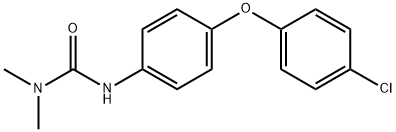
weeds | | General Description | Odorless colorless powder or white crystals. Used as a selective pre- and early post-emergence herbicide in soybeans, strawberries, various vegetable crops and ornamentals. Root- and foliage-absorbed herbicide selective in leek, celery, onion, carrot and strawberry. | | Reactivity Profile | Fire may produce irritating or poisonous gases. When heated to decomposition CHLOROXURON emits very toxic fumes of chlorides and nitrogen oxides. [EPA, 1998]. | | Health Hazard | This is highly toxic by ingestion. Under certain conditions, CHLOROXURON will form carcinogenic dimethylnitrosamine. | | Health Hazard | Exhibits acute, delayed, and chronic toxicity; moderately toxic by intraperitonealroute; low to moderately toxic by ingestion—LD50 values showing wide variationwith species; the data reported appear tobe questionable; highly toxic in dog butlow oral toxicity in rat; toxic effects inhumans unknown but expected to be similar to other urea derivatives; susceptible toformation of dimethylnitrosamine under certain conditions, which is carcinogenic; EPA-listed extremely toxic substance (U.S. EPA1989).LD50 oral (rat): 3700 mg/kg (Lewis 1995)LD50 oral (dog): 10 mg/kg (RTECS 1985). | | Fire Hazard | (Non-Specific -- Pesticide, Solid, n.o.s.) Fire may produce irritating or poisonous gases. When heated to decomposition CHLOROXURON emits very toxic fumes of chlorides and nitrogen oxides. | | Potential Exposure | A potential danger to those involved in the manufacture, formulation, and application of chloroxuron for use as a selective pre- and early postemergency herbicide in soybeans, strawberries; various vegetable crops, and ornamentals. It is a root- and foliageabsorbed herbicide selective in leek, celery, onion, carrot, and strawberry. | | Environmental Fate | Soil. Hartley and Kidd (1987) reported 4-(4-chlorophenoxy)aniline as a soil metabolite.
Chloroxuron was degraded by microorganisms in humus soil and a sandy loam to form
N′-(4-chlorophenoxy)phenyl-N-methylurea, N′-(4-chloro-phenoxy)phenylurea and (4-
chlorophenoxy)aniline and two minor unidentified compounds (Geissbühler et al., 1963a).
Residual activity in soil is limited to approximately 4 months (Hartley and Kidd, 1987).Plant. In plants, chloroxuron is degraded to monomethylated and demethylated derivatives followed by decarboxylation forming 4-(4-chlorophenoxy)aniline (Humburg et al.,
1989)Photolytic. The UV irradiation of an aqueous solution of chloroxuron for 13 hours
resulted in 90% decomposition of the herbicide. Products identified (% yield) were mono-
(2.2%) and didemethylated (4.2%) products and carbon dioxide (64%) (PlimmerChemical/Physical. Hydrolyzes in strong acids and bases forming 4-(4-chloro-phenoxy)aniline (Hartley and Kidd, 1987). Emits toxic fumes of nitrogen oxides, cyanides
and chlorine when heated to decomposition (Sax and Lewis, 1987) | | Shipping | UN2767 Phenylurea pesticides, solid, toxic, Hazard Class: 6.1; Labels: 6.1-Poisonous materials | | Incompatibilities | Incompatible with oxidizers (chlorates, nitrates, peroxides, permanganates, perchlorates, chlorine, bromine, fluorine, etc.); contact may cause fires or explosions. Keep away from alkaline materials, strong bases, strong acids, oxoacids, epoxides. | | Waste Disposal | Incinerate in a unit with effluent gas scrubbing. In accordance with 40CFR165, follow recommendations for the disposal of pesticides and pesticide containers. Must be disposed properly by following package label directions or by contacting your local or federal environmental control agency, or by contacting your regional EPA office. |
| CHLOROXURON Preparation Products And Raw materials |
|

 日本语
日本语 한국어
한국어 Français
 Deutsch
 España
 Türkiye