Other grades of this product :
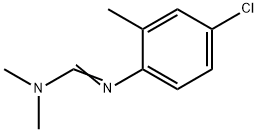
| CHLORDIMEFORM Basic information |
| CHLORDIMEFORM Chemical Properties |
| Melting point | 35° | | Boiling point | 293℃ | | density | 1.05 | | refractive index | nD25 1.5885 | | Fp | 131℃ | | storage temp. | 2-8°C | | form | neat | | pka | 7.89±0.50(Predicted) | | Water Solubility | 0.27g/L(20 ºC) | | Merck | 13,2100 | | BRN | 9256367 | | IARC | 3 (Vol. 30, Sup 7) 1987 | | EPA Substance Registry System | Chlordimeform (6164-98-3) |
| CHLORDIMEFORM Usage And Synthesis |
| Uses | Acaricide, insecticide. | | Uses | Broad-spectrum acaricide used against adult mites, eggs and larvae. Also used as
an insecticide against cockroaches, cotton bollworm, cotton budworm, and other pests. | | Definition | Ovicide, insecticide, and miticide designed for use
on cotton and vegetable crops. Available in a concentrated emulsion form, it is stated to be less toxic
than organophosphates and is biodegradable. | | Hazard | Questionable carcinogen. | | Safety Profile | Poison by ingestion,
skin contact, and intraperitoneal routes.
Experimental reproductive effects. Human
mutation data reported. An eye irritant.
Questionable carcinogen with experimental
carcinogenic data. When heated to
decomposition it emits very toxic fumes of
NOx and Cl-. | | Environmental Fate | Plant. Principal soil and/or plants metabolites are p-chloro-o-toluidine, N′-(4-chloroo-tolyl)-N-methylformamidine (desmethylchlorphenamidine) and N-formyl-p-chloro-otoluidine (Verschueren, 1983). p-Chloro-o-toluidine, N′-(4-chloro-o-tolyl)-N-methylformamidine (desmethylchlor phenamidine) and N-formyl-p-chloro-o-toluidine were identified
in rice grains and straws at concentrations of 3–61, 0.2–1, 10–38 and 80–6,900, 10–180,
67–500 ppb, respectively (Iizuka and Masuda, 1979).
Witkonton and Ercegovich (1972) studied the transformation of chlordimeform in six
different fruits following foliar spray application. They found 4′-chloro-o-formotoluidide
was the only major metabolite identified in apples, pears, cherries, plums, strawberries
and peaches.
Chemical/Physical. Reacts with acids forming soluble salts (Hartley and Kidd, 1987).
Emits toxic fumes of nitrogen oxides and chlorine when heated to decomposition (Sax
and Lewis, 1987). |
| CHLORDIMEFORM Preparation Products And Raw materials |
|


 日本语
日本语 한국어
한국어 Français
 Deutsch
 España
 Türkiye