Other grades of this product :
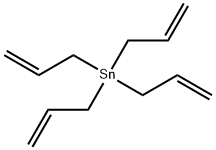
| Tetraallyltin Basic information |
| Tetraallyltin Chemical Properties |
| Boiling point | 69-70 °C1.5 mm Hg(lit.) | | density | 1.179 g/mL at 25 °C(lit.) | | refractive index | n20/D 1.539(lit.) | | Fp | 167 °F | | form | Liquid | | Specific Gravity | 1.179 | | color | Clear colorless | | Water Solubility | Not miscible in water or difficult to mix. | | Sensitive | Air Sensitive | | BRN | 3536269 | | Exposure limits | ACGIH: TWA 0.1 mg/m3; STEL 0.2 mg/m3 (Skin)NIOSH: IDLH 25 mg/m3; TWA 0.1 mg/m3 | | CAS DataBase Reference | 7393-43-3(CAS DataBase Reference) |
| Hazard Codes | T | | Risk Statements | 23/24/25 | | Safety Statements | 23-24/25-45-36/37 | | RIDADR | UN 2788 6.1/PG 3 | | WGK Germany | 3 | | F | 10-23 | | TSCA | No | | HazardClass | 6.1 | | PackingGroup | II | | HS Code | 29310099 |
| Tetraallyltin Usage And Synthesis |
| Chemical Properties | Clear Colorless liquid | | Uses | Applied as allyl transfer reagent. | | Purification Methods | Possible contaminants are allyl chloride and allyltin chloride. Check the 1H NMR and IR [Fishwick & Wallbridge J Organomet Chem 25 69 1970], and if impure, dissolve it in Et2O and shake it with a 5% aqueous solution of NaF which precipitates allyltin fluoride. Separate the Et2O layer, dry (MgSO4) and distil it at ~ 0.2mm. It decomposes slightly on repeated distillation. [O'Brien et al. Inorg Synth XIII 75 1972, Fishwick et al. J Chem Soc (A) 57 1971, Beilstein 4 III 1922.] |
| Tetraallyltin Preparation Products And Raw materials |
|


 日本语
日本语 한국어
한국어 Français
 Deutsch
 España
 Türkiye