Other grades of this product :
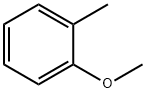
| 2-Methylanisole Basic information |
| 2-Methylanisole Chemical Properties |
| Hazard Codes | F | | Risk Statements | 10 | | Safety Statements | 16 | | RIDADR | UN 1993 3/PG 3 | | WGK Germany | 3 | | Hazard Note | Flammable | | TSCA | Yes | | HazardClass | 3 | | PackingGroup | III | | HS Code | 29093090 |
| 2-Methylanisole Usage And Synthesis |
| Chemical Properties | o-Methylanisole has a pungent, warm, floral odor with earthy, walnut undertones. It has a sweet, fruity, nut-like flavor
at low levels. | | Physical properties | clear colorless to light yellow liquid. soluble in alcohol and ether, insoluble in water. | | Occurrence | Reported found in starfruit, mastic gum oil and rooibus tea (Aspalathus linearis). | | Uses | The catalytic system of disubstituted aromatics was optimized for the 2-methylanisole reduction by a proper choice of the amine/Rh ratio which should be high enough to stabilize very small colloidal rhodium particles and low enough to avoid deactivation. The total synthesis of (±)-heliannuol D and its epimer has been completed in 9 steps and 12% overall yield from 2-methylanisole. The thermal activation of 2-methylanisole (60°C) by the Ir (III) complex TpMe2Ir (C6H5) 2 (N2)(1; TpMe2= hydrotris (3, 5-dimethylpyrazolyl) borate) yielded a mixture of hydride complexes. The total synthesis of the phenolic sesquiterpene mutisianthol has been accomplished in 12 steps from the readily available 2-methylanisole. The catalytic system was optimized for the 2-methylanisole reduction by a proper choice of the amine/Rh ratio which should be high enough to stabilize very small colloidal rhodium particles and low enough to avoid deactivation. | | Definition | ChEBI: 2-methylanisole is a monomethoxybenzene that is o-cresol in which phenolic hydroxy group has been converted to the corresponding methyl ether. A 'green' solvent (b.p. 171°C) and food flavour ingredient, it is found in mastic oils, virgin olive oils and frankincense. It has a role as a polar aprotic solvent and a flavouring agent. It is a monomethoxybenzene, a volatile organic compound and a member of toluenes. It derives from an o-cresol. | | Preparation | 2-Methylanisole is synthesized by methylation of o-cresol using dimethylsulfate in caustic soda at 40°C.synthesis of 2-methylanisole: Make sodium hydroxide into a 20% solution, stir and mix with o-cresol, cool to below 10°C, and slowly add dimethyl sulfate dropwise. After the addition was completed, the temperature was raised to 40 °C for 20 min, and then reacted with 100 °C for 12 h. Then the reactant was washed with water until neutral, water was removed, distilled, and the fraction at 171°C was collected to obtain the finished product of 2-methylanisole. | | Aroma threshold values | Detection: 600 ppb. Aroma characteristics at 1.0%: naphthyl, camphoreous, phenolic and woody with a
salicylate nuance. | | Taste threshold values | Taste characteristics at 5.0 ppm: camphoreous, earthy, woody and alicylate with minty, spicy nuances. | | General Description | 2-Methylanisole is found in mastic oils, virgin olive oils and frankincense. It is a monomethoxybenzene and acts as an intermediate for the preparation of compounds with methylhydroquinone core. | | Flammability and Explosibility | Flammable |
| 2-Methylanisole Preparation Products And Raw materials |
|


 日本语
日本语 한국어
한국어 Français
 Deutsch
 España
 Türkiye