Other grades of this product :
| NADPH, Tetrasodium Salt Basic information |
| NADPH, Tetrasodium Salt Chemical Properties |
| Melting point | >250°C (dec.) | | storage temp. | Keep in dark place,Inert atmosphere,Store in freezer, under -20°C | | solubility | 10 mM NaOH: soluble50mg/mL, clear | | form | Powder | | color | White to Off-white | | Water Solubility | Soluble in water (50 mg/ml). | | Sensitive | Light Sensitive | | Merck | 14,6348 |
| NADPH, Tetrasodium Salt Usage And Synthesis |
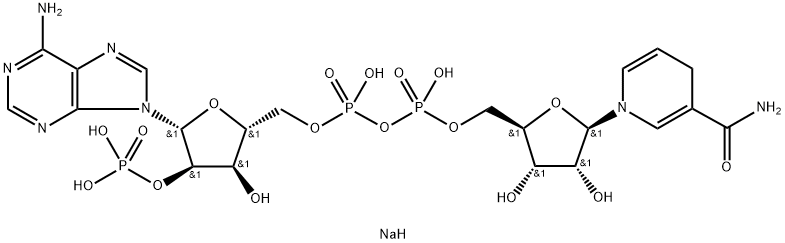
| Description | NADPH is the reduced form of the coenzyme NADP+; used in anabolic reactions such as lipid and nucleic acid synthesis, which require NADPH as a reducing agent.NADPH, Tetrasodium Salt is a A ubiquitous coenzyme that acts as an electron donor in many reactions utilizing dehydrogenase and reductase enzymes. It is generated by reduction of the electron acceptor NADP+. The following biological pathways involve NADPH: formation of carbohydrate from CO2 during photosynthesis, maintenance of high levels of reduced glutathione in erythrocytes, reduction of thioredoxin. | | Chemical Properties | off-white to light yellow powder | | Uses | One of the biologically active forms of nicotinic acid. Differs from NAD by an additional phosphate group at the 2’position of the adenosine moiety. Serves as a coenzyme of hydrogenases and dehydroge
nases. Present in living cells primarily in the reduced form (NADPH) and is involved in synthetic reactions. | | Uses | NADPH tetra sodium salt is used as an ubiquitous cofactor and biological reducing agent. β-NADPH is a coenzyme found in all living cells and is involved in redox reactions carrying electrons from one reaction to another. It is used as an electron donor, cofactor for many redox enzymes including nitric oxide synthetase. | | Uses | β-Nicotinamide adenine dinucleotide 2′-phosphate (NADP+) and β-Nicotinamide adenine dinucleotide 2′-phosphate, reduced (NADPH) comprise a coenzyme redox pair (NADP+:NADPH) involved in a wide range of enzyme catalyzed oxidation reduction reactions. The NADP+/NADPH redox pair facilitates electron transfer in anabolic reactions such as lipid and cholesterol biosynthesis and fatty acyl chain elongation. The NADP+/NADPH redox pair is used in a variety of antioxidation mechanism where it protects agains reactive oxidation species accumulation. NADPH is generated in vivio by the pentose phosphate pathway (PPP). | | Application | NADPH is the reduced form of the electron acceptor nicotinamide adenine dinucleotide phosphate (NADP+) and acts as an electron donor in various biological reactions. In plants, NADPH is produced by ferredoxin-NADP+ reductase in the last step of the electron chain during photosynthesis. In animals is it predominantly produced by the pentose phosphate pathway, but is also generated by key mitochondrial enzymes. NADPH provides the reducing equivalents for biosynthetic reactions and the oxidation-reduction involved in protecting against the toxicity of reactive oxygen species.It is also used for the synthesis of lipids and cholesterol and during the process of fatty acid chain elongation. | | General Description | A ubiquitous coenzyme that acts as an electron donor in many reactions utilizing dehydrogenase and reductase enzymes. It is generated by reduction of the electron acceptor NADP+. The following biological pathways involve NADPH: formation of carbohydrate from CO2 during photosynthesis, maintenance of high levels of reduced glutathione in erythrocytes, reduction of thioredoxin. | | Biological Activity | NADPH is an electron donor and a cofactor for many redox enzymes including nitric oxide synthetase.β-Nicotinamide adenine dinucleotide 2′-phosphate (NADP+) and β-Nicotinamide adenine dinucleotide 2′-phosphate, reduced (NADPH) comprise a coenzyme redox pair (NADP+:NADPH) involved in a wide range of enzyme catalyzed oxidation reduction reactions. The NADP+/NADPH redox pair facilitates electron transfer in anabolic reactions such as lipid and cholesterol biosynthesis and fatty acyl chain elongation. The NADP+/NADPH redox pair is used in a variety of antioxidation mechanism where it protects agains reactive oxidation species accumulation. NADPH is generated in vivio by the pentose phosphate pathway (PPP). | | Biochem/physiol Actions | NADPH is an electron donor and a cofactor for many redox enzymes including nitric oxide synthetase. | | Purification Methods | Purification is mostly similar to that of NADH above. [Beilstein 26 III/IV 3671.] |
| NADPH, Tetrasodium Salt Preparation Products And Raw materials |
|


 日本语
日本语 한국어
한국어 Français
 Deutsch
 España
 Türkiye