Other grades of this product :
| Tricyclazole Basic information |
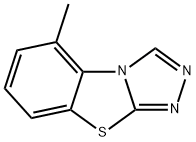
| Product Name: | Tricyclazole | | Synonyms: | 8-Methyl-[1,2,4]triazolo[3,4-b][1,3]benzothiazole;Tricyclazole Standard;5-methyl-1,2,4-triazole(3,4-beta)benzothiazole;Beam (TM) 50mg [41814-78-2];5-Methylbenzo[4,5]thiazolo[2,3-c][1,2,4]triazole;ANTI-BIM BH3 DOMAIN antibody produced in rabbit;Bcl2-interacting mediator of cell death;BCL2L11 | | CAS: | 41814-78-2 | | MF: | C9H7N3S | | MW: | 189.24 | | EINECS: | 255-559-5 | | Product Categories: | pesticide;Agricultural Usage;Fungicides;OthersPesticides&Metabolites;Pesticides;Q-ZAlphabetic;HERBICIDE;Alpha sort;TP - TZ | | Mol File: | 41814-78-2.mol |
| Tricyclazole Chemical Properties |
| Hazard Codes | Xn | | Risk Statements | 22 | | RIDADR | 2588 | | WGK Germany | 1 | | RTECS | XZ5475000 | | HazardClass | 6.1(a) | | PackingGroup | II | | HS Code | 29349990 |
| Tricyclazole Usage And Synthesis |
| Description | log Kow: 1.4. Solubility: In water at 25 ?C,
1.6 g/L. In acetone 10.4, methanol 25, xylene 2.1 (all in
g/l, 25 ?C). Stability: Stable at 52 ?C. Relatively stable
to ultraviolet light. | | Uses | Tricyclazole is an common active ingredient in several commercial fungicide products used to control rice blast fungus, in transplanted and direct-seeded rice. | | Definition | ChEBI: A triazolobenzothiazole that is [1,2,4]triazolo[3,4-b][1,3]benzothiazole which is substituted at position 5 by a methyl group. A fungicide used for the control of rice blast, it is not approved for use within the European Union. | | Metabolism | Animals: Rapid and extensive metabolism.
Plants: The principal metabolite is the hydroxymethyl
analog. Soil/Environment: Kd 4 (loamy sand, pH 6.5, 1.5%
o.m.), 45 (loam, pH 5.7, 3.1% o.m.), 21 (clay loam, pH 7.4,
1.9% o.m.), 22 (silty clay loam, pH 5.7, 4.1% o.m.). | | Toxicity evaluation | Mammalian toxicology. Oral: Acute oral LD50
for rats 314, mice 245, dogs >50 mg/kg. Skin and eye:
Acute percutaneous LD50 for rabbits >2000 mg/kg. Slight
eye irritant; nonirritating to skin (rabbits). Inhalation:
LC50 (1 h) for rats 0.146 mg/L air. NOEL: (2 yr) for
rats 9.6 mg/kg b.w.; for mice 6.7 mg/kg b.w.; (1 yr) for
dogs 5 mg/kg b.w.; 3-generation reproduction for rat
3 mg/kg b.w. ADI: 0.03 mg/kg. Toxicity class: World
Health Organization (WHO) (a.i.) II; U.S. Environmental
Protection Agency (EPA) (formulation) II RC risk Xn
(R22). Ecotoxicology. Birds: Acute oral LD50 for mallard
ducks and bobwhite quail >100 mg/kg. Fish: LC50 for
bluegill sunfish 16.0, rainbow trout 7.3, goldfish fingerlings
13.5 mg/l. Daphnia: LC50 (48 h) > 20 mg/l; NOEC (21 d)
0.96 mg/L. |
| Tricyclazole Preparation Products And Raw materials |
|


 日本语
日本语 한국어
한국어 Français
 Deutsch
 España
 Türkiye