Other grades of this product :
| Cyclopentylamine Basic information |
| Cyclopentylamine Chemical Properties |
| Melting point | -85°C | | Boiling point | 106-108 °C(lit.) | | density | 0.863 g/mL at 25 °C(lit.) | | vapor pressure | 26.72hPa at 20℃ | | refractive index | n20/D 1.450(lit.) | | Fp | 63 °F | | storage temp. | Flammables area | | form | Liquid | | pka | pK1:10.65(+1) (25°C) | | color | Clear | | explosive limit | 1.3-9.40%(V) | | Water Solubility | MISCIBLE | | BRN | 635706 | | LogP | 0.83 at 20℃ | | CAS DataBase Reference | 1003-03-8(CAS DataBase Reference) | | NIST Chemistry Reference | Cyclopentanamine(1003-03-8) | | EPA Substance Registry System | Cyclopentanamine (1003-03-8) |
| Cyclopentylamine Usage And Synthesis |
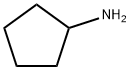
| Chemical Properties | a colorless liquid with an ammoniacal odor. | | Uses | Cyclopentylamine acts as an important raw material and intermediate used in organic synthesis and pharmaceuticals. Further, it serves as chemokine receptor 2 antagonists. It acts as a ligand in coordination chemistry and forms cis-dichlorobis(cyclopentylamine)platinum(II) complex. | | Preparation | Cyclopentylamine is produced from cyclopentanone and ammonia over nickel catalysts at 20 MPa and 150 – 200℃ in the presence of circulating hydrogen over a fixedbed catalyst. | | Application | Cyclopentylamine is used in small amounts as an intermediate for the potato and rice fungizide pencycuron (Bayer, Nihon Tokushu, Noyaku Seizo). | | Flammability and Explosibility | Highlyflammable | | Purification Methods | The amine may contain H2O or CO2 in the form of carbamate salt. Dry it over KOH pellets and then distil it from a few pellets of KOH. Store it in a dark, dry CO2-free atmosphere. It is characterised as the thiocyanate salt m 94.5o. The benzenesulfonyl derivative has m 68.5-69.5o. [Roberts & Chambers J Am Chem Soc 73 5030 1951, Bollinger et al. J Am Chem Soc 75 1729 1953, Beilstein 12 IV 4.] |
| Cyclopentylamine Preparation Products And Raw materials |
|


 日本语
日本语 한국어
한국어 Français
 Deutsch
 España
 Türkiye