Other grades of this product :
| DIBUTYL CARBONATE Basic information |
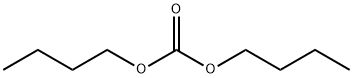
| Product Name: | DIBUTYL CARBONATE | | Synonyms: | DI-N-BUTYL CARBONATE;DIBUTYL CARBONATE;CARBON DIOXIDEDI-N-BUTYL ESTER;BUTYL CARBONATE;Carbonic acid, dibutyl ester;Carbonic acid, di-n-butyl ester;Carbonicacid,dibutylester;carbonicaciddibutylester | | CAS: | 542-52-9 | | MF: | C9H18O3 | | MW: | 174.24 | | EINECS: | 208-816-0 | | Product Categories: | Inhibitors;CARBONATES | | Mol File: | 542-52-9.mol |
| DIBUTYL CARBONATE Chemical Properties |
| Melting point | <25 °C | | Boiling point | bp 206.6° | | density | d420 0.9251; d425 0.9388 | | refractive index | nD20 1.4117 | | storage temp. | 2-8°C | | form | clear liquid | | color | Colorless to Almost colorless | | EPA Substance Registry System | Carbonic acid, dibutyl ester (542-52-9) |
| DIBUTYL CARBONATE Usage And Synthesis |
| Chemical Properties | liquid | | Uses | Dibutyl Carbonate is a potential fuel substitute due to the observed decrease in CO2 emissions. Also used in CO2 catalytic activation. | | Preparation | A 160 mL Parr autoclave was charged with butanol 982 (2.22 g, 0.03 mol), N-cyclohexyl-N',N',N'',N''-tetramethylguanidine (CyTMG; 6.9 g, 0.035 mol), and acetonitrile (30 mL). The autoclave was attached to a pressure head, and 160 psig CO2 was introduced with stirring at room temperature. An exothermic reaction ensued, leading to an increase in temperature to ca. 40℃. In a Fischer–Porter bottle was placed a solution of 1-chlorobutane (8.33 g, 0.09 mol) in acetonitrile (10 mL). This bottle was attached to a pressure head, and 80 psig CO2 was introduced above the solution. After 1 h, the solution of 1-chlorobutane was added in one portion under 80 psig CO2 to the pre-formed carbonate anion solution generated in the autoclave. After the addition, the pressure was increased to 160 psig with CO2, and the reaction mixture was warmed to 85 ℃ for 16 h. Thereafter, the reaction mixture was allowed to cool to room temperature, and then the pressure was released. An aliquot was removed, diluted with diethyl ether, and CyTMGH+Cl- was filtered off; by GC analysis using biphenyl as an internal standard, the yield of dibutyl carbonate was calculated as 73%; oil. | | Flammability and Explosibility | Notclassified |
| DIBUTYL CARBONATE Preparation Products And Raw materials |
|


 日本语
日本语 한국어
한국어 Français
 Deutsch
 España
 Türkiye