Other grades of this product :
| 3-Chloro-1,2-propanediol Chemical Properties |
| Melting point | -40°C | | Boiling point | 213 °C(lit.) | | density | 1.322 g/mL at 25 °C(lit.) | | vapor pressure | 0.04 mm Hg ( 25 °C) | | refractive index | n20/D 1.480(lit.) | | Fp | >230 °F | | storage temp. | 2-8°C | | solubility | H2O: soluble | | form | Liquid | | pka | 13.28±0.20(Predicted) | | color | Clear pale yellow | | Water Solubility | Soluble | | FreezingPoint | -40℃ | | Merck | 14,2145 | | BRN | 635684 | | LogP | 0.5 at 25℃ | | CAS DataBase Reference | 96-24-2(CAS DataBase Reference) | | IARC | 2B (Vol. 101) 2013 | | NIST Chemistry Reference | 1,2-Propanediol, 3-chloro-(96-24-2) | | EPA Substance Registry System | 3-Chloro-1,2-propanediol (96-24-2) |
| 3-Chloro-1,2-propanediol Usage And Synthesis |
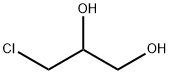
| Description | 3-Chloro-1, 2-propanediol is unusually formed upon the thermal processing of fat-containing foods1. It is useful in organic synthesis. It is an intermediate for the drug dyphylline; used as a solvent for acetate, etc., and as an intermediate for plasticizers, surfactants, and dyes2; be used as a solvent for preparing a plasticizer, a surfactant, a dye intermediate, a drug, or as a dye intermediate mainly for use as an acetyl fiber or the like. Also used as a plasticizer, surfactant and dye intermediate. In the pharmaceutical industry, it is used in the production of phlegm and phlegm and phlegm-removing guaiac oil ether, antiasthmatic drug theophylline, and hydroxyphylline. It is warned that it is a potential carcinogen and has antifertility activity1,3.
| | Sources |
- https://en.wikipedia.org/wiki/3-MCPD
- https://www.sigmaaldrich.com/catalog/product/aldrich/107271?lang=en®ion=US
- Gunn, S. A., T. C. Gould, and W. A. Anderson. "Possible mechanism of posttesticular antifertility action of 3-chloro-1, 2-propanediol. " Proceedings of the Society for Experimental Biology & Medicine Society for Experimental Biology & Medicine 132.2(1969): 656.
| | Chemical Properties | Clear pale yellow liquid | | Uses | A metabolite of Dichloropropanols | | Uses | To lower the freezing point of dynamite; in the manufacture of dye intermediates. As rodent chemosterilant. | | Uses | (±)-3-Chloro-1,2-propanediol may be used as a reference standard for the determination of (±)-3-chloro-1,2-propanediol in food samples by gas chromatography with mass spectrometric detection (GC-MS). | | Uses | It is used in the synthesis of glycerol esters,amines, and other derivatives; to lower thefreezing point of dynamite; and as a rodentchemosterilant (Merck 1989). | | Definition | ChEBI: A chloropropane-1,2-diol that is propane-1,2-diol substituted by a chloro group at position 3. | | Synthesis Reference(s) | Organic Syntheses, Coll. Vol. 1, p. 294, 1941Synthetic Communications, 24, p. 1959, 1994 DOI: 10.1080/00397919408010203Synthesis, p. 295, 1989 | | General Description | A colorless liquid. Denser than water. Contact may irritate skin, eyes and mucous membranes. May be toxic by ingestion. Used to make other chemicals. | | Air & Water Reactions | Soluble in water. Hygroscopic. | | Reactivity Profile | 3-Chloro-1,2-propanediol is hygroscopic and may be sensitive to prolonged exposure to air. Glycols and their ethers undergo violent decomposition in contact with approximately 70% perchloric acid. . | | Hazard | Toxic by ingestion, inhalation. | | Health Hazard | Glycerol α-monochlorohydrin is a highlytoxic, teratogenic, and carcinogenic com pound. It is also an eye irritant.Inhalation of 125 ppm in 4 hours wasfatal to rats. The lethal dose on mice viaintraperitoneal route was 10 mg/kg. Lowdosage can cause sleepiness, and on chronicexposure, weight lossLD50 value, oral (rats): 26 mg/kThis compound is a strong teratomer,causing severe reproductive effects. Animal studies indicated that the adverse effects wereof spermatogenesis type, related to the testes,sperm duct, and Cowper’s gland. These werepaternal effectsStudies on rats indicated that high exposure levels to glycerol chlorohydrin can giverise to thyroid tumors. | | Health Hazard | TOXIC; inhalation, ingestion or skin contact with material may cause severe injury or death. Contact with molten substance may cause severe burns to skin and eyes. Avoid any skin contact. Effects of contact or inhalation may be delayed. Fire may produce irritating, corrosive and/or toxic gases. Runoff from fire control or dilution water may be corrosive and/or toxic and cause pollution. | | Fire Hazard | Combustible material: may burn but does not ignite readily. When heated, vapors may form explosive mixtures with air: indoors, outdoors and sewers explosion hazards. Contact with metals may evolve flammable hydrogen gas. Containers may explode when heated. Runoff may pollute waterways. Substance may be transported in a molten form. | | Flammability and Explosibility | Nonflammable | | Safety Profile | Poison by ingestion and
intraperitoneal routes. Moderately toxic by
inhalation. Experimental reproductive
effects. A severe eye irritant. Questionable
carcinogen with experimental tumorigenic
data. Mutation data reported. A
chemosterilant for rodents. Combustible
when exposed to heat or flame. Reaction
with perchloric acid forms a sensitive
explosive product more powerful than
glyceryl nitrate. When heated to
decomposition it emits toxic fumes of Cl-. | | Waste Disposal | Chemical incineration is the most appropriatemethod of disposal. |
| 3-Chloro-1,2-propanediol Preparation Products And Raw materials |
|


 日本语
日本语 한국어
한국어 Français
 Deutsch
 España
 Türkiye