Other grades of this product :
| Isoprothiolane Basic information |
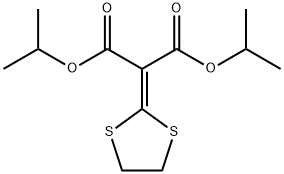
| Product Name: | Isoprothiolane | | Synonyms: | fuji1;NKK 100;nkk100;NNF-109;Propanedioic acid, 1,3-dithiolan-2-ylidene-, bis(1-methylethyl) ester;Propanedioicacid,1,3-dithiolan-2-ylidene-,bis(1-methylethyl)ester;SS 11946;ss11946 | | CAS: | 50512-35-1 | | MF: | C12H18O4S2 | | MW: | 290.4 | | EINECS: | | Product Categories: | FUNGICIDE | | Mol File: | 50512-35-1.mol |
| Isoprothiolane Chemical Properties |
| Hazard Codes | Xn,N | | Risk Statements | 22-51/53 | | Safety Statements | 61 | | RIDADR | UN 3077 9 / PGIII | | WGK Germany | 3 | | HS Code | 29341000 | | Toxicity | LD50 oral in rabbit: 2320mg/kg |
| Isoprothiolane Usage And Synthesis |
| Uses | Isoprothiolane is a dithiolane pesticide. Isoprothiolane is commonly used in agriculture as a fungicide to control planthoppers and blast disease in rice plants. | | Uses | Isoprothiolane is a fungicide that is used to control rice blast
(Pyriculuriu aryzae), rice stem rot and Fusarium leaf spot on rice. It also
reduces the plant-hopper population on rice. | | Hazard | Moderately toxic by ingestion. | | Metabolic pathway | Isoprothiolane is easily oxidized by rat liver 9000 g
supernatant to produce its racemic sulfoxide in this
process, NADPH is an effective cofactor but NADH is
not. The liver microsomes, however, preferentially
form its (?+)-isomer in an enantiomeric excess of
38-43%. The sulfoxidation of isoprothiolane by rice
plants proceeds too slowly to determine the
metabolites. Both isoprothiolane (+?)- and (-)-
sulfoxides undergo rapid racemization by rat cytosol
(105 000 g supernatant) or rice plants, accompanied
with reduction to isoprothiolane. | | Degradation | Half-lives of isoprothiolane in river water were greater than 50 days
(Hayakawa et. al., 1992). The compound is decomposed slowly in deionised
water under UV light or sunlight. In rice paddy water, photodegradation
was greatly accelerated by the presence of natural organic
constituents (Chou and Eto, 1980; Eto et al., 1979). Isoprothiolane was
placed on a silica gel TLC plate and irradiated at 10 cm distance with a
10 W lamp emitting mainly at 254 nm. Isoprothiolane photodegraded
rapidly (half-life about 3 hours). Five products were detected. Proposed
pathways of photodegradation are shown in Scheme 1 and involved
cleavage of the dithiolane ring, ester hydrolysis, decarboxylation and the
formation of dimeric heterocyclic compounds. The identities of oxalic acid
(2), dithiolanylidenemalonic acid (3), dithiolanylideneacetic acid (4), 2,4-
bis[bis(isopropoxycarbonyl)methylene]-1,3-dithietane (5), 3,5-bis[bis(isopropoxycarbonyl)
methylene]-1,2,4-trithiolane (6) and elemental sulfur
were confirmed. Isoprothiolane degraded more rapidly on sand than on
a glass plate (Chou and Eto, 1980). |
| Isoprothiolane Preparation Products And Raw materials |
| Raw materials | Sulfuric acid-->Benzene-->Hexane-->Isopropyl alcohol-->Sodium cyanide-->Carbon disulfide-->Dichloroethane-->Sodium chloroacetate-->MALONIC ACID DISODIUM SALT-->Diisopropyl malonate-->Isopropylmalonic acid-->3,6,7,10-Tetrathiadodeca-1,11-diene-1,1,12,12-tetracarboxylic acid, 2,11-dimethoxy-, tetrakis(1-methylethyl) ester, 6-oxide (9CI)-->L-Cysteine methyl ester hydrochloride |
|


 日本语
日本语 한국어
한국어 Français
 Deutsch
 España
 Türkiye