Other grades of this product :
| 1,2,3-TRICHLOROPROPENE Basic information |
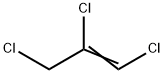
| Product Name: | 1,2,3-TRICHLOROPROPENE | | Synonyms: | 1,2,3-trichlor-1-propene;1,2,3-trichloro-1-propen;1,2,3-Trichloro-1-propene;1,2,3-trichloro-propen;1,2,3-Trichloropropene, E&Z;1-Propene,1,2,3-trichloro-;2,3-Dichloroallyl chloride;2,3-dichloroallylchloride | | CAS: | 96-19-5 | | MF: | C3H3Cl3 | | MW: | 145.41 | | EINECS: | 202-487-7 | | Product Categories: | | Mol File: | 96-19-5.mol |
| 1,2,3-TRICHLOROPROPENE Chemical Properties |
| 1,2,3-TRICHLOROPROPENE Usage And Synthesis |
| General Description | An amber liquid. Flash point 185°F. Boiling range 280-304°F (depending on purity). Density 12 lb / gal. May be absorbed through the skin. Vapors are heavier than air. Contact with vapors or liquid may cause burns or irritation. | | Air & Water Reactions | Flammable. | | Reactivity Profile | 1,2,3-TRICHLOROPROPENE incompatible with strong oxidizing and reducing agents. Incompatible with many amines, nitrides, azo/diazo compounds, with alkali metals, and with epoxides. Reacts with bases. Produces toxic fumes when heated to decomposition. Avoid contact with iron, plastics, and aluminum. | | Health Hazard | TOXIC; inhalation, ingestion or skin contact with material may cause severe injury or death. Contact with molten substance may cause severe burns to skin and eyes. Avoid any skin contact. Effects of contact or inhalation may be delayed. Fire may produce irritating, corrosive and/or toxic gases. Runoff from fire control or dilution water may be corrosive and/or toxic and cause pollution. | | Fire Hazard | Combustible material: may burn but does not ignite readily. When heated, vapors may form explosive mixtures with air: indoors, outdoors and sewers explosion hazards. Contact with metals may evolve flammable hydrogen gas. Containers may explode when heated. Runoff may pollute waterways. Substance may be transported in a molten form. | | Safety Profile | Moderately toxic by ingestion,inhalation, and skin contact. Mutation data reported. Aneye and severe skin irritant. Combustible when exposed toheat, flames (sparks) or powerful oxidizers. To fight fire,use water (as a blanket), spray, mist, dry chemic |
| 1,2,3-TRICHLOROPROPENE Preparation Products And Raw materials |
| Raw materials | Dichloroethane-->1,1,2,2-Tetrachloropropane-->Propane, 1,1,2,3-tetrachloro-2-fluoro--->1,1,2,3-TETRACHLOROPROPANE-->1,2,2,3-TETRACHLOROPROPANE-->Pentachloropropane-->1,1,3-TRICHLOROPROPENE-->Water-->2,3-Dichloropropene-->Propyne |
|


 日本语
日本语 한국어
한국어 Français
 Deutsch
 España
 Türkiye