Other grades of this product :
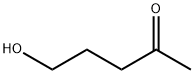
| 3-Acetyl-1-propanol Basic information |
| 3-Acetyl-1-propanol Chemical Properties |
| Melting point | 2.5°C (estimate) | | Boiling point | 144-145 °C/100 mmHg (lit.) | | density | 1.007 g/mL at 25 °C (lit.) | | refractive index | n20/D 1.437(lit.) | | Fp | 200 °F | | storage temp. | 2-8°C | | pka | 14.89±0.10(Predicted) | | form | Liquid | | color | Colorless to Light yellow to Light orange | | CAS DataBase Reference | 1071-73-4(CAS DataBase Reference) | | NIST Chemistry Reference | 2-Pentanone, 5-hydroxy-(1071-73-4) |
| Hazard Codes | Xi | | Risk Statements | 36/37/38 | | Safety Statements | 37/39-26 | | WGK Germany | 2 | | RTECS | UA4600000 | | HS Code | 29144000 | | Toxicity | LD50 orl-rat: 6400 mg/k TNICS* 13,118,73 |
| 3-Acetyl-1-propanol Usage And Synthesis |
| Chemical Properties | clear colorless liquid | | Uses | 3-Acetopropanol is a substrate for alcohol dehydrogenase and is an intermediate in the synthesis of Didesethyl Chloroquine (D440960), a metabolite of Chloroquine. | | Synthesis Reference(s) | Journal of the American Chemical Society, 75, p. 4456, 1953 DOI: 10.1021/ja01114a018Tetrahedron Letters, 26, p. 5713, 1985 DOI: 10.1016/S0040-4039(01)80928-X | | Safety Profile | Moderately toxic by ingestion andinhalation. When heated to decomposition it emits acridsmoke. |
| 3-Acetyl-1-propanol Preparation Products And Raw materials |
|


 日本语
日本语 한국어
한국어 Français
 Deutsch
 España
 Türkiye