Other grades of this product :
| L-Selenomethionine Basic information |
| L-Selenomethionine Chemical Properties |
| Melting point | 265 °C | | alpha | 18 º (c=1, 1N HCl) | | Boiling point | 320.8±37.0 °C(Predicted) | | refractive index | 18 ° (C=0.5, 2mol/L HCl) | | storage temp. | -20°C | | solubility | H2O: 50 mg/mL | | pka | 2.26±0.10(Predicted) | | form | powder | | color | white to off-white | | Water Solubility | soluble | | Merck | 14,8441 | | InChIKey | RJFAYQIBOAGBLC-BYPYZUCNSA-N | | CAS DataBase Reference | 3211-76-5(CAS DataBase Reference) |
| L-Selenomethionine Usage And Synthesis |
| Chemical Properties | Solid | | Uses | A compound shown to increase expression of glutathione peroxidase | | Uses | Seleno-L-methionine has been used: - in toxicity studies in Japanese Medaka embryos
- to study its effects on selenium status indicators in pregnant long-tailed macaques (Macaca Fascicularis)
- to label proteins for single wavelength anomalous dispersion (SAD) phasing
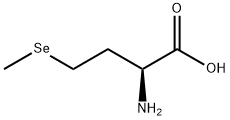
| | Definition | ChEBI: The L-enantiomer of selenomethionine. | | General Description | Seleno-L-Methionine (SeMet), an organic form of selenium is found in Cupriavidus metallidurans. | | Biochem/physiol Actions | Seleno-L-Methionine (SeMet) is capable of repressing atopic dermatitis (AD)-like skin lesions. It can also prevent the expression of total immunoglobulin E (IgE) and interleukin 4 (IL-4). It can cause ecotoxicity as it is absorbed by fish through diet. |
| L-Selenomethionine Preparation Products And Raw materials |
|


 日本语
日本语 한국어
한국어 Français
 Deutsch
 España
 Türkiye