Other grades of this product :
| METHYL CINNAMATE Basic information |
| METHYL CINNAMATE Chemical Properties |
| Melting point | 34-38 °C(lit.) | | Boiling point | 260-262 °C(lit.) | | density | 1.078 | | refractive index | 1.5766 | | FEMA | 2698 | METHYL CINNAMATE | | Fp | >230 °F | | storage temp. | Sealed in dry,Room Temperature | | solubility | Chloroform (Slightly), Ethyl Acetate (Slightly) | | form | neat | | color | White to Off-White |
| Safety Statements | 22-24/25 | | WGK Germany | 1 | | RTECS | GE0190000 | | HS Code | 2916399090 |
| METHYL CINNAMATE Usage And Synthesis |
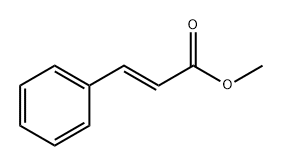
| Chemical Properties | Methyl Cinnamate occurs in essential oils, mostly as the transisomer.
It is the main component of oils isolated from Alpinia species (content up to 80%) and Ocimum canum varieties (>50%). It has also been identified as a
volatile aroma component of cinnamon and strawberries.
Methyl cinnamate is a colorless crystalline solid (mp 36.5°C) with a fruity,
sweet, balsamic odor. In addition to the common esterification methods, it can
be prepared by Claisen condensation of benzaldehyde and methyl acetate in the
presence of sodium. Methyl cinnamate is used in soap perfumes, as well as in
blossom and oriental perfumes, and is sometimes added to aromas. | | Uses | Methyl trans-cinnamate was used to inhibit monophenolase and diphenolase activity of mushroom tyrosinase. | | General Description | Methyl trans-cinnamate has antimicrobial ability. |
| METHYL CINNAMATE Preparation Products And Raw materials |
|


 日本语
日本语 한국어
한국어 Français
 Deutsch
 España
 Türkiye