Other grades of this product :
| Cupric oxalate Basic information |
| Cupric oxalate Chemical Properties |
| Melting point | anhydrous decomposes at ~300 to copper oxide [HAW93] | | storage temp. | Refrigerator, under inert atmosphere | | solubility | Aqueous Base (Slightly) | | form | Powder | | color | blue | | Water Solubility | insoluble | | Solubility Product Constant (Ksp) | pKsp: 9.35 | | CAS DataBase Reference | 814-91-5(CAS DataBase Reference) | | EPA Substance Registry System | Cupric oxalate (814-91-5) |
| Cupric oxalate Usage And Synthesis |
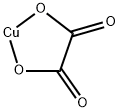
| Chemical Properties | Cupric oxalate is a bluish-white, odorless powder. | | Uses | As catalyst for organic reactions; as stabilizer for acetylated polyformaldehyde; in anticaries compositions; in seed treatments to repel birds and rodents. | | Preparation | Copper(II) oxalate can be prepared by reaction of sodium oxalate with copper(II) salt solutions. Copper(II) oxalate is used as a catalyst in organic reactions and as a stabilizer for acetylated polyformaldehyde. | | General Description | Odorless bluish-white solid. Denser than water and insoluble in water. Hence sinks in water. Used as a catalysts for organic reactions. | | Air & Water Reactions | Insoluble in water. | | Reactivity Profile | Cupric oxalate dissolves in aqueous ammonia and reacts as an acid to neutralize other bases as well. Can serve as a reducing agent in reactions that generate carbon dioxide. | | Hazard | Toxic by ingestion; tissue irritant. | | Health Hazard | Inhalation causes irritation of nose and throat. Ingestion of very large amounts may produce symptoms of oxalate poisoning; watch for edema of the glottis and delayed constriction of esophagus. Contact with eyes causes irritation. | | Fire Hazard | Special Hazards of Combustion Products: Toxic carbon monoxide gas may form in fire. | | Potential Exposure | Used as a catalyst for organic reactions and in seed treatment as a repellent for birds and rodents. | | Shipping | UN2775, Copper based pesticides, solid, toxic, Hazard Class: 6.1; Labels: 6.1-Poisonous materials. | | Incompatibilities | Explosive materials are formed on contact with acetylene gas, ammonia, caustic solutions; sodium hypobromite, nitromethane. Slight heating can cause a weak explosion. Cupric oxalate dissolves in aqueous ammonia and reacts as an acid to neutralize other bases as well. Can serve as a reducing agent in reactions that generate carbon dioxide. Incompatible with oxidizers (chlorates, nitrates, peroxides, permanganates, perchlorates, chlorine, bromine, fluorine, etc.); contact may cause fires or explosions. Keep away from alkaline materials, strong bases, strong acids, oxoacids, epoxides. |
| Cupric oxalate Preparation Products And Raw materials |
|


 日本语
日本语 한국어
한국어 Français
 Deutsch
 España
 Türkiye