Other grades of this product :
| IMINOCTADINE TRIACETATE Basic information |
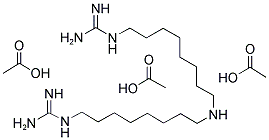
| Product Name: | IMINOCTADINE TRIACETATE | | Synonyms: | N,N'''-[Iminobis(8,1-octanediyl)]bisguanidine/acetic acid,(1:x);Bis (8-guanidinooctyl) amine acetate;DF-125;IMINOCTADINE TRIACETATE;GUAZATINE TRIACETATE;N,N'''-(iminodi-8,1-octanediyl)bisguanidinium acetate;Guanidine, N,N-(iminodi-8,1-octanediyl)bis-, acetate;25% IMINOCTADINE TRIACETATE SOLUTION | | CAS: | 39202-40-9 | | MF: | C24H53N7O6 | | MW: | 535.72 | | EINECS: | 254-351-1 | | Product Categories: | | Mol File: | 39202-40-9.mol |
| IMINOCTADINE TRIACETATE Chemical Properties |
| vapor pressure | <0.4 x 10⁻³ Pa (23 °C) | | storage temp. | 0-6°C
| | pka | >9, >13, >13 (strong base) | | Water Solubility | 764,000 mg l-1 (25 °C) |
| RIDADR | 2588 | | HazardClass | 6.1(a) | | PackingGroup | I |
| IMINOCTADINE TRIACETATE Usage And Synthesis |
| Uses | Iminoctadine triacetate is used as a seed treatment or spray for
control of Septoriu nodorum, Tilletia caries, Fusarium spp. and Helminthosporium
spp. in cereals. It is also used on citrus fruit and apples. | | Metabolic pathway | Iminoctadine is a strong base with two guanidino groups with pKa >13
and an amino group with pKa >9. It is ionised at all pH values typically
encountered in the environment. Although the tri-cation is highly polar
it will be strongly sorbed to soils by the ion exchange mechanism as well
as by hydrophobic interactions of its alkyl chains. Amino compounds
usually readily form unextractable residues in soils. For these reasons the
fungicide is strongly sorbed to soils and there it has low biological availability
to plants and animals and is protected from microbial degradation.
The only major identified products of transformation were products of
photooxidation and the deamidinated products detected in rats. | | Degradation | Iminoctadine triacetate is stable in neutral and aqueous acidic media but
unstable in alkaline conditions. There was no appreciable hydroysis of
iminoctadine in buffer solutions at pH 5,7 and 9 after one month at 25 °C
(PM). [14C-guanidine]Iminoctadinetr iacetate was coated onto glass plates
and exposed to artificial (12 hours day-1) or natural sunlight. Loss by
volatilisation was negligible over 336 hours. Photodegradation was initially
rapid (DT50 40 hours) but subsequently slowed (DT50 912 hours).
One major and several minor photoproducts were detected after irradiation
for 336 hours and in total represented 69% of the applied radioactivity
of which the major product accounted for 31%. The major
metabolite was converted into pyrimidine derivatives to aid analysis
by IR, NMR and MS methods. The major photoproduct was tentatively
identified as 4- or 6-methyl-5-oxo-9-azaheptadecane-1,17-diguanidine
(2 or 3, Scheme 1) and it was formed by photo-oxidation and methylation
of adjacent methylene groups. One of the intermediates in the formation
of 2 or 3 was another unidentified photo-oxidation product of iminoctadine
(Sato et al., 1985b). |
| IMINOCTADINE TRIACETATE Preparation Products And Raw materials |
|


 日本语
日本语 한국어
한국어 Français
 Deutsch
 España
 Türkiye