Other grades of this product :
| N-Acetyl-L-cysteine ethyl ester Basic information |
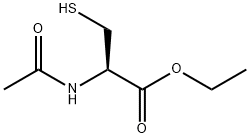
| Product Name: | N-Acetyl-L-cysteine ethyl ester | | Synonyms: | ethyl (2R)-2-acetamido-3-sulfanylpropanoate;Acetylcysteine Impurity H;101242;2-acetamido-3-mercaptopropanoic acid ethyl ester;Ethyl N-acetyl-L-cysteinate;N-Acetyl-L-cysteine ethyl ester;L-Cysteine, N-acetyl-, ethyl ester;N-Acetylcysteine ethylester | | CAS: | 59587-09-6 | | MF: | C7H13NO3S | | MW: | 191.25 | | EINECS: | 000-000-0 | | Product Categories: | | Mol File: | 59587-09-6.mol |
| N-Acetyl-L-cysteine ethyl ester Chemical Properties |
| Melting point | 44.1-44.5 °C | | Boiling point | 337.6±32.0 °C(Predicted) | | density | 1.138±0.06 g/cm3(Predicted) | | storage temp. | 2-8°C | | pka | 9.17±0.10(Predicted) |
| N-Acetyl-L-cysteine ethyl ester Usage And Synthesis |
| Description | N-acetyl-L-Cysteine ethyl ester is an esterified form of N-acetyl-L-cysteine (NAC; ). It has enhanced cell permeability in isolated perfused rat liver compared to NAC. N-acetyl-L-Cysteine ethyl ester (1 mM) prevents tert-butyl hydroperoxide-induced formation of methemoglobin in isolated human red blood cells. It increases glutathione levels in rat liver, kidney, heart, testis, and brain when administered at a dose of 50 mg/kg twice per day for two weeks. N-acetyl-L-Cysteine ethyl ester reduces increases in plasma aspartate aminotransferase (AST), alanine aminotransferase (ALT), and lactate dehydrogenase (LDH) levels induced by paracetamol (acetaminophen; ) in rats. |
| N-Acetyl-L-cysteine ethyl ester Preparation Products And Raw materials |
|


 日本语
日本语 한국어
한국어 Français
 Deutsch
 España
 Türkiye