Other grades of this product :
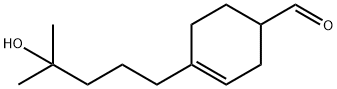
| Product Name: | Lyral | | Synonyms: | 3-CYCLOHEXENE-1-CARBOXALDEHYDE, 4-(4-HYDROXY-4-METHYL PENTYL);4(4-hydroxy-4-methylpentyl)3-cyclohexene carboxaldehyde;Hydroxymethylpentylcyclohexenecarboxaldehyde;4-HYDROXY-4-METHYLPENTYL-3-CYCLOHEXENE-CARBOXALDEHYDE;HYDROXYMETHYLPENTYLCYCLOHEXENE-CARBOXYALDEHYDE;4-(4-Hydroxy-4-methylpentyl)cyclohex-3-encarbaldehyd;4-(4-HYDROXY-4-METHYLPENTYL)-3-CYCLOHEXENE-1-CARBOXALDEHYE;LYRAL | | CAS: | 31906-04-4 | | MF: | C13H22O2 | | MW: | 210.31 | | EINECS: | 250-863-4 | | Product Categories: | C10 to C21Organic Building Blocks;Aldehydes;Alkenes;Carbonyl Compounds;Cyclic | | Mol File: | 31906-04-4.mol |
| Lyral Chemical Properties |
| RIDADR | UN1230 - class 3 - PG 2 - Methanol, solution | | WGK Germany | 2 | | RTECS | GW2850000 | | F | 10-23 |
| Lyral Usage And Synthesis |
| Chemical Properties | Colorless liquid | | Chemical Properties | Lyral is a colorless,
viscous liquid with a sweet odor reminiscent of lily of the valley. The aldehyde can
be prepared by a Diels–Alder reaction of myrcenol and acrolein in the presence
of a Lewis catalyst (e.g., zinc chloride).
Reaction ofmyrcenol with acrolein at elevated temperatures, without a catalyst,
yields a 70 : 30 mixture of the 4- and 3-substituted cyclohexene carboxaldehydes
.This mixture is a commercial product. The title compound has excellent
fixative properties and is used especially in soap and cosmetics perfumery: | | Uses | hydroxyisohexyl 3-cyclohexene carboxaldehyde is fragrance with a light floral scent. It may cause skin irritation. | | Uses | Lyral (mixture of isomers) is a suspected fragrance allergen. | | Trade name | Lydocal (Hangzhou), Lyral® (IFF) | | Contact allergens | Lyral ? is a synthetic blend of two isomers, and one of
the most frequently encountered allergen in perfumes.
It has to be listed by name in the ingredients of cosmet-
ics in the EU, according to the seventh amendment of
the cosmetic directive 76/768/EEC. |
| Lyral Preparation Products And Raw materials |
|


 日本语
日本语 한국어
한국어 Français
 Deutsch
 España
 Türkiye