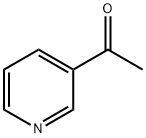
| 3-Acetylpyridine Basic information |
| Identification Description Regulatory Status Usage Natural occurrence |
| Product Name: | 3-Acetylpyridine |
| Synonyms: | 1-(3-pyridenyl)ethanone;1-(3-pyridinyl)-ethanon;3-Acetylpiridine;3-acetyl-pyridin;beta-Acetylpyridine;Ketone, methyl 3-pyridyl;ketone,methyl3-pyridyl;Methyl beta-pyridyl ketone |
| CAS: | 350-03-8 |
| MF: | C7H7NO |
| MW: | 121.14 |
| EINECS: | 206-496-7 |
| Product Categories: | ACETYLGROUP;Pyridine;Carbonyl Compounds;Heterocycles;Heterocycle-Pyridine series;ketone;Pyridines, Pyrimidines, Purines and Pteredines;Pyridines derivates;Pyridines;pyridine Flavor;Osteoporosis;Aromatics;350-03-8 |
| Mol File: | 350-03-8.mol |
| 3-Acetylpyridine Chemical Properties |
| Melting point | 11-13 °C (lit.) |
| Boiling point | 220 °C (lit.) |
| density | 1.102 g/mL at 25 °C (lit.) |
| vapor pressure | 0.3Pa at 20℃ |
| FEMA | 3424 | 3-ACETYLPYRIDINE |
| refractive index | n |
| Fp | 302 °F |
| storage temp. | Inert atmosphere,Room Temperature |
| form | Liquid |
| pka | pK1: 3.256(+1) (25°C) |
| Specific Gravity | 1.102 |
| color | Clear colorless to yellow |
| PH | 6.5-7.5 (H2O, 20℃) |
| Water Solubility | SOLUBLE IN HOT WATER |
| Merck | 14,6116 |
| JECFA Number | 1316 |
| BRN | 107751 |
| InChIKey | WEGYGNROSJDEIW-UHFFFAOYSA-N |
| LogP | 0.34 at 13℃ |
| CAS DataBase Reference | 350-03-8(CAS DataBase Reference) |
| NIST Chemistry Reference | Ethanone, 1-(3-pyridinyl)-(350-03-8) |
| EPA Substance Registry System | Ethanone, 1-(3-pyridinyl)- (350-03-8) |
| Safety Information |
| Hazard Codes | T,Xi,Xn |
| Risk Statements | 25-36/38-36/37/38-20/21/22 |
| Safety Statements | 45-37/39-28A-26-36 |
| RIDADR | UN 2810 6.1/PG 3 |
| WGK Germany | 3 |
| RTECS | OB5425000 |
| F | 8-10 |
| Hazard Note | Irritant |
| TSCA | Yes |
| HazardClass | 6.1 |
| PackingGroup | II |
| HS Code | 29333999 |
| Toxicity | LD50 orl-rat: 46 mg/kg JACTDZ 1,681,92 |
| MSDS Information |
| Provider | Language |
|---|---|
| Methyl 3-pyridyl ketone | English |
| SigmaAldrich | English |
| ACROS | English |
| ALFA | English |
| 3-Acetylpyridine Usage And Synthesis |
| Identification | ▼ ▲ CAS.No.:
350-03-8
FL.No.:
14.039
FEMA.No.:
3424
NAS.No.:
3424
CoE.No.:
2316
EINECS.No.:
206-496-7
JECFA.No.:
1316
|
| Description | A colorless liquid with sweet, nutty, popcorn-like aroma. |
| Regulatory Status | CoE: Used provisionally. Bev.: 2 ppm; Food: 3 ppm FDA: n/a FDA (other): n/a JECFA: ADI: Acceptable. No safety concern at current levels of intake when used as a flavoring agent (2004). |
| Usage | Reported uses (ppm): (FEMA, 1994)
▼ ▲ Food Category
Usual
Max.
Baked goods
2
3
Frozen dairy
1
2
Gelatins,puddings
1
2
Nonalcoholic beverages
1
2
Soft candy
2
3
|
| Natural occurrence | Reported found in roasted filberts, beer, brandy, coffee, malt and wheaten bread. |
| Chemical Properties | clear colorless to yellow liquid |
| Chemical Properties | A colorless liquid with sweet, nutty, popcorn-like aroma |
| Occurrence | Reported found in roasted filberts, beer, brandy, coffee, malt and wheaten bread. |
| Uses | 3-Acetylpyridine used as an intermediate for the synthesis of risedronate sodium, inhibitor of bone resorption. It is also used in perfumery. |
| Uses | Used in the fragrance industry and as an intermediate in the synthesis of a number of clinical drugs, including Imatinib, Mesylate, Metyrapone, Telithromycin, and Ridogrel. An analog of nicotinamide that competes for incorporation into NAD. It has been used to chemically lesion the inferior olive nucleus, thereby eliminating climbing fibers within the cerebellar cortex. |
| Preparation | Dry distillation of calcium nicotinate with calcium acetate. |
| Definition | It is a nicotinic acidantagonist. |
| Safety Profile | Poison by ingestion. Moderately toxic by intraperitoneal routeMutation data reported. A flammable liquid. When heated to decomposition emits toxic fumes of NOx,. See also KETONES |
| Purification Methods | It is purified by dissolving in HCl, extracting with Et2O to remove the possible impurity of nicotinic acid, basified with NaOH and extracted with Et2O. The dried extract is filtered, evaporated and the residual oil is distilled. If the NMR spectrum indicates further impurities, then convert it to the phenylhydrazone (m 137o, yellow needles from EtOH). This is hydrolysed with HCl [Engler & Kiby Chem Ber 22 597 1889], the phenylhydrazine HCl is removed by filtration, NaNO2 is added, the solution is basified with aqueous NaOH and extracted with Et2O as before and distilled at atmospheric pressure to give 3-acetylpyridine as a colourless oil. Purification can also be achieved by shaking with 50% aqueous KOH, extracting with Et2O, drying the extract and distilling it at atmospheric pressure or in vacuo. [Kloetzel & Chubb J Am Chem Soc 79 4226 1957.] The hydrochloride has m 180-181o (from MeOH/EtOH), the picrate has m 133.8-134.8o (from H2O), and the phenylhydrazone has m 137o (129-130o)(needles, from EtOH) [Webb & Webb J Am Chem Soc 71 2285 1949]. The ketoxime has m 112o (from EtOH or *C6H6). [Strong & McElvain J Am Chem Soc 55 816 1933, Kolloff & Hunter J Am Chem Soc 63 490 1941, Beilstein 21/7 V 394.] |
| 3-Acetylpyridine Preparation Products And Raw materials |
Please leave a message for us or use the following ways to contact us, we will reply to you as soon as possible, and provide you with the most sincere service, thank you.


 日本语
日本语 한국어
한국어 Français
 Deutsch
 España
 Türkiye