Other grades of this product :
| PROCAINE Basic information |
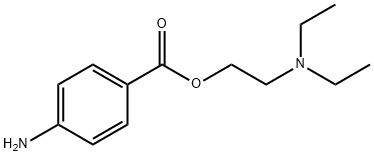
| Product Name: | PROCAINE | | Synonyms: | 2-(Diethylamino)ethyl 4-aminobenzoate;2-(Diethylamino)ethyl p-aminobenzoate;2-(diethylamino)ethylp-aminobenzoate;2-diethylaminoethyl4-aminobenzoate;2-Diethylaminoethylester kyseliny p-aminobenzoove;2-diethylaminoethylesterkyselinyp-aminobenzoove;2-diethylaminoethylp-aminobenzoate;4-Aminobenzoic acid diethylaminoethyl ester | | CAS: | 59-46-1 | | MF: | C13H20N2O2 | | MW: | 236.31 | | EINECS: | 200-426-9 | | Product Categories: | API;59-46-1 | | Mol File: | 59-46-1.mol |
| PROCAINE Chemical Properties |
| Melting point | 61° | | Boiling point | 378.78°C (rough estimate) | | density | 1.0604 (rough estimate) | | refractive index | 1.5430 (estimate) | | storage temp. | Keep in dark place,Sealed in dry,Room Temperature | | solubility | DMSO (Slightly), Methanol (Slightly) | | form | Solid | | pka | pKa 9.04±0.01(H2O,t=25,I=0.1(NaCl))(Approximate) | | color | White to Off-White | | Water Solubility | 9.45g/L(30 ºC) | | Merck | 14,7757 | | Stability: | Hygroscopic | | CAS DataBase Reference | 59-46-1(CAS DataBase Reference) | | NIST Chemistry Reference | Benzoic acid, 4-amino-, 2-(diethylamino)ethyl ester(59-46-1) |
| RIDADR | 3249 | | RTECS | DG2100000 | | HazardClass | 6.1(b) | | PackingGroup | III | | Hazardous Substances Data | 59-46-1(Hazardous Substances Data) | | Toxicity | LD50 in mice (mg/kg): 195 i.p.; 45 i.v. (North, Urbach) |
| PROCAINE Usage And Synthesis |
| Description | Procaine is a local anesthetic with a para-amino function. Sensitization mainly concerns medical, dental
and veterinary professions. | | Chemical Properties | The hydrochloride salt
of 2-(diethylamino) ethyl p-aminobenzoate (C13H21ClN2O2
or N2C6H4COOCH2CH2NH(C2H5)2HCl) is generally
referred to as procaine. Although the PABA ester is insoluble in water, the
hydrochloride salt is very soluble in water. | | Uses | Procaine (Novocain) is mainly used in dental or medical
procedures requiring infiltration anesthesia, peripheral
block, or spinal block. | | Uses | inhibitor of sodium channel | | Uses | Procaine is a sodium channel blocker and inhibitor of a variety of processes. | | Definition | ChEBI: A benzoate ester, formally the result of esterification of 4-aminobenzoic acid with 2-diethylaminoethanol but formed experimentally by reaction of ethyl 4-aminobenzoate with 2-diethylaminoethanol. | | Brand name | Novocain (Hospira). | | Biological Functions | Procaine hydrochloride (Novocain) is readily hydrolyzed
by plasma cholinesterase, although hepatic
metabolism also occurs. It is not effective topically but
is employed for infiltration, nerve block, and spinal
anesthesia. It has a relatively slow onset and short (1
hour) duration of action. All concentrations can be
combined with epinephrine. It is available in dental cartridges
with phenylephrine as the vasoconstrictor. | | General Description | Procaine was synthesized in 1904 to address the chemical instabilityof cocaine and the local irritation it produced. The pKa of procaine is 8.9; it has low lipid solubility and the estergroup is unstable in basic solutions. Procaine is available inconcentrations ranging from 0.25% to 10% with pHs adjustedto 5.5 to 6.0 for chemical stability. Procaine is also includedin some formulations of penicillin G to decrease the pain ofintramuscular injection. | | Contact allergens | Procaine is a local anesthetic with para-amino function.
Sensitization mainly concerns the medical, dental,
and veterinary professions. | | Clinical Use | Procaine is very quickly metabolizedin the plasma by cholinesterases and in the liver via ester hydrolysisby a pseudocholinesterase. The in vitroelimination half-life is approximately 60 seconds. Any conditionthat decreases the cholinesterase concentration may increaseexposure to procaine and potential toxicity. Decreasedenzyme activity can be found with genetic deficiency, liverdisease, malignancy, malnutrition, renal failure, burns, thirdtrimester of pregnancy, and following cardiopulmonary bypasssurgery. Ester hydrolysis produces PABA, the compoundresponsible for the allergic reactions common to theester anesthetics. Procaine is not used topically because of itsinability to pass through lipid membranes and finds use as aninfiltration agent for cutaneous or mucous membranes, forshort procedures. Procaine is also used for peripheral nerveblock and as an epidural agent to diagnose pain syndromes. | | Purification Methods | Procain crystallises as the dihydrate from aqueous EtOH and as the anhydrous material from pet ether or diethyl ether. The latter is hygroscopic. [Beilstein 14 IV 1138.] |
| PROCAINE Preparation Products And Raw materials |
|


 日本语
日本语 한국어
한국어 Français
 Deutsch
 España
 Türkiye