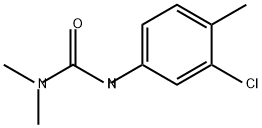
| Chlorotoluron Basic information |
| Product Name: | Chlorotoluron |
| Synonyms: | 3-(3-chlor-4-methylphenyl)-1,1-dimethylharnstoff;3-(3-chloro-4-methylphenyl)-1,1-dimethyl-urea;3-(3-Chloro-4-methylphenyl)-N,N-dimethylurea;3-(3-chloro-p-tolyl)-1,1-dimethyl-ure;tolurex;N'-(3-Chloro-4-methylphenyl)-N,N-dimethylurea;n-(3-chloro-4-methylphenyl)-n',n'-dimethylurea;DICURAN(R) |
| CAS: | 15545-48-9 |
| MF: | C10H13ClN2O |
| MW: | 212.68 |
| EINECS: | 239-592-2 |
| Product Categories: | Agro-Products;Amines;CHPesticides&Metabolites;Alphabetic;C;Aromatics;ACTIVE AGROCHEMICAL INGREDIENTS;HERBICIDE;Herbicides;Urea structure |
| Mol File: | 15545-48-9.mol |
| Chlorotoluron Chemical Properties |
| Melting point | 148.3° |
| Boiling point | 367.8±42.0 °C(Predicted) |
| density | 1.2426 (rough estimate) |
| refractive index | 1.6000 (estimate) |
| Fp | 2 °C |
| storage temp. | APPROX 4°C |
| form | neat |
| pka | 14.43±0.70(Predicted) |
| Water Solubility | 70.43mg/L(20 ºC) |
| Merck | 13,2191 |
| BRN | 2647688 |
| CAS DataBase Reference | 15545-48-9(CAS DataBase Reference) |
| NIST Chemistry Reference | Chlortoluron(15545-48-9) |
| EPA Substance Registry System | Chlorotoluron (15545-48-9) |
| Safety Information |
| Hazard Codes | Xn;N,N,Xn,F |
| Risk Statements | 40-50/53-63-36-20/21/22-11 |
| Safety Statements | 26-36/37-46-60-61-16 |
| RIDADR | UN 3077 |
| WGK Germany | 3 |
| RTECS | YS7230000 |
| Hazardous Substances Data | 15545-48-9(Hazardous Substances Data) |
| MSDS Information |
| Provider | Language |
|---|---|
| 3-(3-Chloro-p-tolyl)-1,1-dimethylurea | English |
| Chlorotoluron Usage And Synthesis |
| Uses | Herbicide. |
| Definition | ChEBI: A member of the class of ureas that is N-methyl urea substituted by a 3-chloro-4-methylphenyl group at position 3 and a methyl group at position 1. A herbicide that is non-toxic to honeybees but is moderately toxic to mammals, birds, ea thworms and most aquatic organisms. |
| Metabolism | Chlortoluron is rapidly metabolized in winter wheat. Hydroxylation of the methyl group on the phenyl ring has been demonstrated as a detoxification mechanism for chlortoluron resistance in winter wheat, whereas in the susceptible weed blackgrass (Alopecurus myosuroides Huds.), the main metabolite is the mono N-demethylated metabolite (107). In a tolerant weed, Persian speedwell (Veronica persica Poir.), chlortoluron is rapidly transformed to the nonphytotoxic di-N-demethylated metabolite (107). |
| Chlorotoluron Preparation Products And Raw materials |
| Raw materials | Hydrochloric acid-->Hydrogen peroxide-->Nickel-->Methylamine-->Carbon disulfide-->Dimethylamine-->Ferric chloride-->PHOSGENE-->CARBON MONOXIDE-->4-Nitrotoluene-->Phenyl isocyanate-->Diffusing agent-->alomond gum,cedo gum-->2-Chloro-4-nitrotoluene-->METHYL ISOCYANATE-->Cyanhydric acid-->PT-C |
| Preparation Products | 3-Chloro-4-methylphenyl isocyanate |
Please leave a message for us or use the following ways to contact us, we will reply to you as soon as possible, and provide you with the most sincere service, thank you.


 日本语
日本语 한국어
한국어 Français
 Deutsch
 España
 Türkiye