Other grades of this product :
| ETHIRIMOL Basic information |
| ETHIRIMOL Chemical Properties |
| Melting point | 159-160° | | Boiling point | 348.66°C (rough estimate) | | density | 1.2100 | | vapor pressure | 2.7 x 10⁻⁴ Pa at 25 °C | | refractive index | 1.5700 (estimate) | | storage temp. | -20°C Freezer | | solubility | Chloroform (Sparingly), Ethanol (Slightly), Methanol (Slightly) | | form | neat | | pka | 5 | | Water Solubility | 253 mg l-1 (pH 5.2), 150 mg l-1 (pH 7.3),
153 mg l-1 (pH 9.3) at 20 °C | | color | White to Off-White | | Merck | 13,3776 | | BRN | 882476 | | EPA Substance Registry System | Ethirimol (23947-60-6) |
| Hazard Codes | Xn | | Risk Statements | 21 | | Safety Statements | 36/37 | | WGK Germany | 1 | | RTECS | UW7380000 | | Toxicity | LD50 orally in rats: 4000 mg/kg (Bebbington) |
| ETHIRIMOL Usage And Synthesis |
| Uses | Fungicide. | | Uses | Ethirimol is a systemic fungicide with both protective and curative
actions. It controls mainly powdery mildew (Erysiphe gmminis) on barley,
wheat and oats. Ethirimol can be applied as a seed dressing, as a foliar
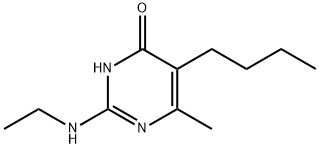
spray or directly to the soil in the root zone. | | Uses | Ethirimol is a pyrimidine based fungicide with wide applications such as controlling leaf spot of sugar beet. | | Definition | ChEBI: An aminopyrimidine that is 2-ethylaminopyrimidin-4-one carrying butyl and methyl substituents at positions 5 and 6 respectively. A fungicide first marketed in 1970 and used as a seed treatment for diseaases such as damping-off, it is not licensed for use w
thin the European Union. | | Metabolic pathway | Ethirimol is susceptible to photodegradation and it also degrades
extensively in soil to yield CO2 and unextractable soil-bound residues.
Metabolism in plants and animals is extensive to yield up to 16 metabolites.
Elimination in animals was rapid following oral dosing. Metabolism
in soil, plants and animals follows common pathways which include
N-dealkylation, hydroxylation of the butyl group and conjugation. | | Degradation | Ethirimol (1) is stable to hydrolytic degradation in buffered solutions
at pH 5, 7 and 9 at 22°C. It degraded under aqueous photolysis test
conditions with a half-life (DT50) of ca. 3 weeks. The primary photolytic
degradation reactions include the opening of the pyrimidine ring to yield
ethylguanidine (2), urea (3) and 4-butylpyrazolidine-3,5-dione (4) (Cavell
et al., 1974c). |
| ETHIRIMOL Preparation Products And Raw materials |
|


 日本语
日本语 한국어
한국어 Français
 Deutsch
 España
 Türkiye