Other grades of this product :
| Copper Peptide Basic information |
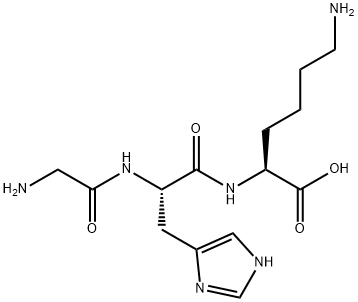
| Product Name: | Copper Peptide | | Synonyms: | GHK Cu Copper Peptide;L-Lysine,glycyl-L-histidyl-;Copper Peptide powder (GHK-cu);GHK Cu Copper Peptide GHK.Cu GHK-Cu;Ahk-cu;Liver Cell Growth Factor(GHK);GHKcu/Growth-Modulating peptide;(Gly-His-Lys)2Cu.xHAc | | CAS: | 49557-75-7 | | MF: | C14H24N6O4 | | MW: | 340.38 | | EINECS: | 1592732-453-0 | | Product Categories: | BEAUTY PEPTIDES;cosmestic;APIs;49557-75-7 | | Mol File: | 49557-75-7.mol |
| Copper Peptide Chemical Properties |
| Melting point | >144°C (dec.) | | Boiling point | 831.0±65.0 °C(Predicted) | | density | 1.324 | | storage temp. | under inert gas (nitrogen or Argon) at 2–8 °C | | solubility | Aqueous Acid (Slightly), DMSO (Slightly) | | form | Solid | | pka | 3.11±0.10(Predicted) | | color | Off-White | | Stability: | Hygroscopic |
| Copper Peptide Usage And Synthesis |
| Description | Copper peptide GHK-Cu is a naturally occurring copper complex of the tripeptide glycyl-L-histidyl-L-lysine. The tripeptide has strong affinity for copper(II) and was first isolated from human plasma. It can be found also in saliva and urine. | | Uses | Copper Peptide(GHK-Cu) can be used as skin antiaging agents. | | Uses | anti-wrikle | | Uses | Glycyl-L-histidyl-L-lysine is a liver cell growth factor and an asynthetic hepatotrophic agent that stimulates hepatic erythropoietic factor production. | | Definition | ChEBI: A tripeptide composed of glycine, L-histidine and L-lysine residues joined in sequence. | | Pharmaceutical Applications | Glycyl-l-histidyl-l-lysine (GHK) is a tripeptide known for its high binding affinity to Cu2+ and its complex
role in wound healing. The GHK–Cu(II) complex was isolated from human plasma in the 1970s and it was
shown to be an activator for wound healing. GHK–Cu(II) has two main functions: as an anti-inflammatory
agent to protect the tissue from oxidative damage after the injury, and as an activator for wound healing itself
as it activates the tissue remodelling.
The structure of GHK is very similar to that of common drugs used to treat ulcers.
After the initial stages of wound healing are activated, such as blood coagulation and neutrophil invasion, a
second stage of wound healing begins, which includes the population of GHK at the wound, which has a high
affinity to Cu2+. Mast cells, which are located in the skin, secrete GHK, which accumulates Cu2+ and forms
the copper complex GHK–Cu(II) and therefore increases the metal–tripeptide concentration at the wound.
First, GHK–Cu(II) has an anti-inflammatory effect by protecting the tissue from oxidative damage and by
suppressing local inflammatory signals (i.e. cytokine interleukin-1 (IL-1)). Second, GHK–Cu(II) is released
into the blood stream and encourages the production of wound macrophages that support the wound repair
by removing the damaged tissue and secreting a family of several growth factor proteins. GHK–Cu(II) also
hinders fibroblast production of TGF-β-1 and therefore suppresses the scar development. The GHK–Cu(II)
complex also stimulates the growth of blood vessels, neurons and elastin, and, in general, supports most
processes of wound healing.
|
| Copper Peptide Preparation Products And Raw materials |
|


 日本语
日本语 한국어
한국어 Français
 Deutsch
 España
 Türkiye