Other grades of this product :
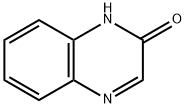
| 2-Quinoxalinone Basic information |
| 2-Quinoxalinone Chemical Properties |
| Melting point | 271-272 °C (lit.) | | Boiling point | 265.75°C (rough estimate) | | density | 1.2312 (rough estimate) | | refractive index | 1.4900 (estimate) | | storage temp. | Sealed in dry,Room Temperature | | solubility | DMSO (Slightly), Methanol (Very Slightly, Heated) | | form | Solid | | pka | 9.20±0.50(Predicted) | | color | Light Brown | | InChIKey | FFRYUAVNPBUEIC-UHFFFAOYSA-N | | CAS DataBase Reference | 1196-57-2(CAS DataBase Reference) | | NIST Chemistry Reference | 2(1H)-quinoxalinone(1196-57-2) | | EPA Substance Registry System | 2(1H)-Quinoxalinone (1196-57-2) |
| 2-Quinoxalinone Usage And Synthesis |
| Chemical Properties | White to yellow to light brown solid | | Uses | 2-Quinoxalinone is a metabolite of Quinalphos, and is known to photocatalytically destroy antioxidant vitamins and biogenic amines in vitro and is genotoxic to both light- and dark-exposed bacteria. | | Definition | ChEBI: A hydroxyquinoxaline that consists of quinoxaline having a single hydroxy substituent located at position 2. | | General Description | Epitaxial crystallization of syndiotactic polypropylene on 2-quinoxalinol yields isochiral form II of syndiotactic polypropylene. 2-Quinoxalinol participates in direct dehydrative cross-coupling of 2-quinoxalinone with p-tolylacetylene via Pd/Cu-catalyzed phosphonium coupling. |
| 2-Quinoxalinone Preparation Products And Raw materials |
|


 日本语
日本语 한국어
한국어 Français
 Deutsch
 España
 Türkiye