Other grades of this product :
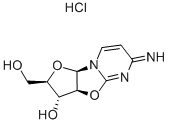
| 2,2'-Anhydro-1-beta-D-arabinofuranosylcytosine hydrochloride Basic information |
| Product Name: | 2,2'-Anhydro-1-beta-D-arabinofuranosylcytosine hydrochloride | | Synonyms: | 1-beta-d-arabinofuranosyl-2,2’-anhydro-cytosinhydrochloride;hydroxy-6-imino-,monohydrochloride,stereoisomer;nsc-145668;o-2,2’-cyclocytidinemonohydrochloride;2,2'-ANHYDRO-(1-BETA-D-ARABINOFURANOSYL)CYTOSINE HYDROCHLORIDE;2,2'-ANHYDROCYTIDINE HYDROCHLORIDE;ANCITABINE HYDROCHLORIDE;Ancitabine hydrochloride,2,2′-Anhydro-(1-β-D-arabinofuranosyl)cytosine hydrochloride, Cyclo-C, Cyclocytidine | | CAS: | 10212-25-6 | | MF: | C9H12ClN3O4 | | MW: | 261.66 | | EINECS: | 233-515-6 | | Product Categories: | API intermediates;Biochemistry;Nucleosides and their analogs;Nucleosides, Nucleotides & Related Reagents | | Mol File: | 10212-25-6.mol |
| 2,2'-Anhydro-1-beta-D-arabinofuranosylcytosine hydrochloride Chemical Properties |
| Melting point | 269-270 °C (dec.)(lit.) | | alpha | -21.8 º (c=2,water) | | refractive index | -21 ° (C=2, H2O) | | storage temp. | Inert atmosphere,2-8°C | | solubility | Methanol (Slightly), Water (Sparingly) | | form | Powder | | color | White | | Merck | 14,629 | | InChIKey | KZOWNALBTMILAP-JBMRGDGGSA-N |
| Safety Statements | 24/25 | | WGK Germany | 2 | | RTECS | LV2615000 | | HS Code | 29213000 |
| 2,2'-Anhydro-1-beta-D-arabinofuranosylcytosine hydrochloride Usage And Synthesis |
| Chemical Properties | white fine crystalline powder | | Originator | Cyclo-C,Kohjin,Japan,1975 | | Uses | Anti-tumor agent | | Uses | Ancitabine Hydrochloride is an antineoplastic agent. | | Uses | antineoplastic | | Definition | ChEBI: A hydrochloride salt resulting from the reaction of equimolar amounts of ancitabine and hydrogen chloride. | | Manufacturing Process | A series of reaction steps may be employed in which: (1) Uridine is reacted
with trityl chloride to give 5'-o-trityluridine; (2) Imidazole is reacted with
thiophosgene and that product reacted with the 5'-o-trityluridine to give 2,2'-
anhydro-1-(5'-o-trityl-β-D-arabinofuranosyl)uracil; (3) The preceding uracil
product is converted to the thiouracil using hydrogen sulfide; (4) The trityl
group is removed by treatment with 80% acetic acid; (5) A triacetylated
product is obtained using acetic anhydride; (6) A dithiouracil is prepared from
the uracil intermediate using phosphate pentasulfide.
Preparation of 1-(β-D-arabinofuranosyl)-2-thiocytosine: A solution of 2.0 g of
1-(2',3',5'-O-triacetyl-β-D-arabinofuranosyl)-2,4-dithiouracilin 100 ml of
methanol is saturated with anhydrous ammonia at 0°C. The mixture, in a
glass liner, is heated in a pressure bomb at 100°C for three hours. The
reaction mixture is concentrated to a gum in vacuum, and most of the
byproduct acetamide is removed by sublimation at 60°C/0.1 mm. The residue
is chromatographed on 100 g of silica gel. Elution of the column with
methylene chloride-methanol mixtures with methanol concentrations of 2-25%
gives fractions containing acetamide and a series of brown gums. The desired
product is eluted with 30% methanol-methylene chloride to give a total yield
of 0.386 g (30%), MP 175-180°C (dec.). Recrystallization from methanolisopropanol
furnishes an analytical sample, MP 180-182°C (dec.).
To a solution of 80 mg of 1-(β-D-arabinofuranosyl)-2-thiocytosine in 12 ml of
water is added dropwise 3 ml of a 1 M bromine solution in carbon
tetrachloride. At this point the color of the bromine persists for about 2-3
minutes after each addition. The unreacted bromine is blown off with a stream
of nitrogen, and the reaction mixture is concentrated to a syrup in vacuum
using a bath temperature less than 50°C. The residue is evaporated three
times with 10 ml portions of ethanol, whereupon it crystallizes. The product is
triturated with cold ethanol and with ether to obtain 17 mg of 2,2'-anhydro-1-
(β-D-arabinofuranosyl)cytosine hydrobromide, MP 240°C (dec.).
Treatment of the hydrobromide with a slight excess of ethanolic ammonia
yields the base which may then be converted to the hydrochloride. | | Therapeutic Function | Antineoplastic |
| 2,2'-Anhydro-1-beta-D-arabinofuranosylcytosine hydrochloride Preparation Products And Raw materials |
|


 日本语
 한국어
 Français
 Deutsch
 España
 Türkiye