Other grades of this product :
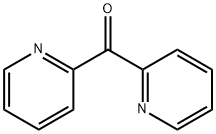
| DI-2-PYRIDYL KETONE Basic information |
| DI-2-PYRIDYL KETONE Chemical Properties |
| Melting point | 52-55 °C (lit.) | | Boiling point | 115-125 °C(Press: 0.1 Torr) | | density | 1.196±0.06 g/cm3(Predicted) | | Fp | >230 °F | | storage temp. | Inert atmosphere,Room Temperature | | pka | 2.30±0.10(Predicted) | | form | Liquid | | color | Clear colorless to yellow | | Water Solubility | Low solubility in water. | | BRN | 126598 | | InChIKey | QPOWUYJWCJRLEE-UHFFFAOYSA-N | | CAS DataBase Reference | 19437-26-4(CAS DataBase Reference) |
| Hazard Codes | Xi | | Risk Statements | 36/37/38 | | Safety Statements | 26-36 | | WGK Germany | 3 | | F | 10 | | HS Code | 29339900 |
| DI-2-PYRIDYL KETONE Usage And Synthesis |
| Chemical Properties | beige to brown crystalline powder | | Uses | di-2-Pyridyl ketone has been used in the preparation of unusual {Ni(II)(3)Ln(III)(?-OR)(6)}(3+) complexes with a "star" topology. Its monoanionic form has been used in the synthesis of triangular Ni(2)M (M = lanthanide, Y) complexes. The Schiff base ligands derived from di-2-pyridyl ketone exhibit ant proliferative activity in SK-N-MC neuroepithelioma (cancer) cells. | | Uses | di-2-Pyridyl ketone has been used in the preparation of unusual {Ni(II)(3)Ln(III)(μ-OR)(6)}(3+) complexes with a "star" topology. Its monoanionic form has been used in the synthesis of triangular Ni(2)M (M = lanthanide, Y) complexes. | | Biochem/physiol Actions | The Schiff base ligands derived from di-2-pyridyl ketone exhibit antiproliferative activity in SK-N-MC neuroepithelioma (cancer) cells. |
| DI-2-PYRIDYL KETONE Preparation Products And Raw materials |
|


 日本语
日本语 한국어
한국어 Français
 Deutsch
 España
 Türkiye