Other grades of this product :
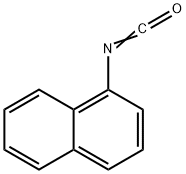
| 1-Naphthyl isocyanate Basic information |
| 1-Naphthyl isocyanate Chemical Properties |
| Melting point | 4 °C (lit.) | | Boiling point | 267 °C/761 mmHg (lit.) | | density | 1.177 g/mL at 25 °C (lit.) | | vapor density | 2.9 (vs air) | | vapor pressure | 168.8 mm Hg ( 37.7 °C) | | refractive index | n20/D 1.6344(lit.) | | Fp | -1 °F | | storage temp. | Inert atmosphere,2-8°C | | solubility | Miscible with alcohol, chloroform and diethyl ether. | | form | clear liquid | | color | Colorless to Light yellow to Light orange | | Sensitive | Moisture Sensitive | | Merck | 14,6410 | | BRN | 742779 | | Stability: | Stable. Incompatible with strong oxidizing agents, alcohols. | | CAS DataBase Reference | 86-84-0(CAS DataBase Reference) | | NIST Chemistry Reference | Naphthalene, 1-isocyanato-(86-84-0) | | EPA Substance Registry System | 1-Isocyanatonaphthalene (86-84-0) |
| 1-Naphthyl isocyanate Usage And Synthesis |
| Chemical Properties | colourless or slightly yellow liquid | | Uses | 1-Naphthyl isocyanate is used in the preparation of cationic aromatic urethane. It is useful for the study of cholangiolitic hepatotoxicity in laboratory animals. It is also employed as separate enantiomers of beta-blockers. | | Synthesis Reference(s) | Synthetic Communications, 23, p. 335, 1993 DOI: 10.1080/00397919308009785 | | Purification Methods | Distil the isocyanate at atmospheric pressure or in a vacuum. It can be crystallised from pet ether (b 60-70o) at low temperature. It has a pungent odour, is TOXIC and is absorbed through the skin. [Beilstein 12 H 1244, 12 III 2948.] |
| 1-Naphthyl isocyanate Preparation Products And Raw materials |
|


 日本语
日本语 한국어
한국어 Français
 Deutsch
 España
 Türkiye