Other grades of this product :
| ACRYLONITRILE/BUTADIENE COPOLYMER Basic information |
| ACRYLONITRILE/BUTADIENE COPOLYMER Chemical Properties |
| ACRYLONITRILE/BUTADIENE COPOLYMER Usage And Synthesis |
| Chemical Properties | NBR is important for its high oil and temperature resistance.
Flexibility at very low temperatures is obtained with lower
acrylonitrile content: in turn, this sacrifices some oil resistance.
Low-temperature flexibility for some applications can
be modified by plasticizers or blends. Additional properties
include resistance to heat, abrasion, and water, as well as
resistance to gas permeation. NBR is frequently plasticized
with organic phosphate, phthalic ester, or dibenzyl ether. | | Uses | Applications include fuel lines,
hoses, automobile parts, structural adhesives, oil-resistant
clothing or articles, gloves, and shoe soles and heels.
Gloves made of nitrile rubber are comparable to neoprene
gloves in their resistance to organic solvents; nitrile rubber
gloves were superior in resistance to II-hexane and inferior in
resistance to phenol. NBR is used for hoses, gaskets, and
protective clothing.
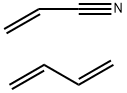
| | Production Methods | NBR is produced by polymerization of acrylonitrile and
butadiene in varying proportions. The basic steps are the
emulsion polymerization techniques used for styrene–
butadiene. The process yields both “hot” and “cold” rubber.
Hot rubbers are branched and contain some cross-linked gel.
The more linear cold rubbers are slightly cross-linked by
incorporating divinyl benzene to improve processability and
compression set resistance. |
| ACRYLONITRILE/BUTADIENE COPOLYMER Preparation Products And Raw materials |
|


 日本语
日本语 한국어
한국어 Français
 Deutsch
 España
 Türkiye