Other grades of this product :
| 6-Hydroxypurine Basic information |
| 6-Hydroxypurine Chemical Properties |
| Melting point | >300 °C (lit.) | | Boiling point | 250.36°C (rough estimate) | | density | 1.4295 (rough estimate) | | refractive index | 1.8500 (estimate) | | storage temp. | 2-8°C | | solubility | 1 M NaOH: 25 mg/mL | | form | powder | | pka | 8.7(at 25℃) | | color | Colorless to yellow to brown, darken on storage with no loss of purity | | Odor | Odorless | | Water Solubility | practically insoluble | | Merck | 14,4869 | | BRN | 5811 | | InChIKey | FDGQSTZJBFJUBT-UHFFFAOYSA-N | | CAS DataBase Reference | 68-94-0(CAS DataBase Reference) | | NIST Chemistry Reference | Hypoxanthine(68-94-0) | | EPA Substance Registry System | Hypoxanthine (68-94-0) |
| Hazard Codes | Xn | | Risk Statements | 36/37/38-22-40 | | Safety Statements | 22-24/25-37/39-26-36 | | WGK Germany | 3 | | RTECS | UP0791000 | | Hazard Note | Harmful | | TSCA | Yes | | HS Code | 29335990 | | Toxicity | LD50 intraperitoneal in mouse: 750mg/kg |
| 6-Hydroxypurine Usage And Synthesis |
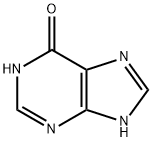
| Description | Hypoxanthine is a naturally occurring purine derivative and intermediate in the synthesis of uric acid. It is elevated in the spinal fluid of patients with Lesch-Nyhan syndrome, a metabolic disorder whose symptoms include cerebral palsy, cognitive deficits, motor dysfunction, self-mutilation, and hyperuricemia. Injection of hypoxanthine (10 μM) increases succinate dehydrogenase and complex II activities and decreases cytochrome c oxidase activity, resulting in neuroenergetic impairment, ATP depletion, and cellular apoptosis in rat striatum. It is also used to induce hyperuricemia in mice for use in the development of hypouricemic agents. | | Chemical Properties | White to off-white powder | | Uses | A naturally occurring purine derivative. Pharmaceuticals, Intermediates & Fine Chemicals | | Uses | Hypoxanthine is a nutrient additive for a variety of cell culture applications involving bacterial, parasite (Plasmodium falciparum) and animal cells. Hypoxanthine is a component of selection media used in hybridoma technologies. | | Uses | Hypoxanthine, is used as a marker for energy perturbation in hypoxia/ ischemia. The compound has been used in studies as in indicator, along with uric acid and allantoin , of in vivo free radical reactions. It has been also used in DNA studies to investigate the destabilizing effect it has on DNA duplexes containing hypoxanthine as a base, in a gas phase versus a liquid phase. Hypoxanthine has also been used in studies along with 8-oxoguanine nucleotides to investigate their interaction with human DNA pol ? (DNA polymerase alpha) and DNA polymerase I from Bacillus stearothermophilus. It is also used as a pharmaceutical intermediate. | | Definition | ChEBI: A purine nucleobase that consists of purine bearing an oxo substituent at position 6. | | General Description | Hypoxanthine (6-hydroxypurine), a purine derivative is a naturally occurring compound. It is the deaminated form of adenine and a breakdown product of adenosine monophosphate (AMP). | | Biochem/physiol Actions | Hypoxanthine?is capable of stimulating cell death. It can also induce reactive oxygen species (ROS). It results in endothelial dysfunction via apoptosis, stimulated by oxidative stress. | | Safety Profile | Moderately toxic by
intraperitoneal route. An experimental
teratogen. When heated to decomposition it
emits toxic fumes of Nox | | Purification Methods | Crystallise it from hot water and dry it at 105o. [Beilstein 26 II 252, 26 III/IV 2081.] |
| 6-Hydroxypurine Preparation Products And Raw materials |
|


 日本语
日本语 한국어
한국어 Français
 Deutsch
 España
 Türkiye