Other grades of this product :
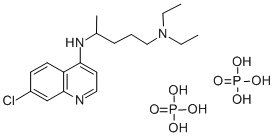
| Chloroquine diphosphate Basic information |
| Chloroquine diphosphate Chemical Properties |
| Melting point | 200 °C (dec.) (lit.) | | storage temp. | protect from light | | solubility | H2O: 50 mg/mL, clear | | form | solid | | pka | pKa 8.10(H2O
t = 20
c = 0.0025) (Uncertain) | | color | White | | PH | pH(100g/l, 25℃) : 3.8~4.3 | | Water Solubility | Soluble in water | | Merck | 14,2163 | | BRN | 4223142 | | Stability: | Stable for 2 years from date of purchase as supplied. Solutions in distilled water may be stored at -20° for up to 3 months. | | InChIKey | QKICWELGRMTQCR-UHFFFAOYSA-N | | CAS DataBase Reference | 50-63-5(CAS DataBase Reference) | | EPA Substance Registry System | Chloroquine diphosphate (50-63-5) |
| Hazard Codes | Xn | | Risk Statements | 22-40-20/21/22 | | Safety Statements | 22-24/25-36 | | RIDADR | 1544 | | WGK Germany | 3 | | RTECS | VB2450000 | | F | 10 | | HazardClass | 6.1(b) | | PackingGroup | III | | HS Code | 2933492250 | | Toxicity | LD50 oral in rat: 623mg/kg |
| Chloroquine diphosphate Usage And Synthesis |
| Description | Chloroquine is an aminoquinoline that is an inhibitor of autophagy and has antimalarial, anti-inflammatory, anticancer, and antiviral activities. Chloroquine inhibits autophagosome-lysosome fusion in HeLa cells when used at a concentration of 100 μM. It is active against the chloroquine-sensitive GC03 strain of P. falciparum (IC50 = 29.2 nM) but has decreased activity against mutant pfcrt P. falciparum (IC50s = 100-150 nM). Chloroquine prevents infection by severe acute respiratory coronavirus 2 (SARS-CoV-2) in Vero cells (EC50 = 1.13 μM) but does not inhibit SARS-CoV replication in the lungs in a mouse model of SARS-CoV infection. It inhibits the growth of human SSC25 and CAL 27 oral squamous cell carcinoma cells (IC50s = 29.9 and 17.3 μM, respectively), as well as A498, SN12C, RXF 393, and 769-P renal cancer cells (IC50s = 16, 62, 81, and 25 μM, respectively). It reduces tumor growth in a CAL 27 mouse xenograft model and a 4T1 mouse allograft model when administered at a dose of 50 mg/kg. Formulations containing chloroquine have been used in the prevention of malaria, as well as the treatment of rheumatoid arthritis and systemic lupus erythematosus (SLE), and have been associated with cardiotoxicity and myopathy. | | Chemical Properties | White Solid | | Originator | Nivaquine,Specia,France,1949 | | Uses | Chloroquine diphosphate salt is used to study the role of endosomal acidification in cellular processes, such as the signaling of intracellular TLRs. It can be used as DNA intercalator & to dissociate antigen antibody complexes without denaturing red blood cell antigens. Chloroquine showed very high antiviral activity against NiV but very little activity against the other viruses at concentrations lower than 20 μM. | | Uses | Standard anti-malarial drug. Substrate for MRP in multidrug resistant cell line and inhibits photoaffinity labelling of MRP by quinoline-based photoactive drug IAAQ | | Uses | antimalarial, antiamebic, antirheumatic, intercalating agent | | Uses | An antimalarial compound | | Manufacturing Process | 105 g of 4,7-dichloroquinoline (MP 93 to 94°C) are heated with 200 g of 1-
diethylamino-4-aminopentane for 7 hours in an oil bath to 180°C while
stirring, until a test portion dissolved in diluted nitric acid does not show a
precipitation with sodium acetate solution. The mixture is dissolved in diluted
acetic acid and made alkaline by adding sodium lye.
The base is extracted with ether, dried with potassium carbonate, the ether
removed by distillation and the residue fractionated. The 4-(5'-
diethylaminopentyl-2'-amino)-7-chloroquinoline (BP 212 to 214C/0.2 mm) is
obtained. On cooling the compound solidifies crystalline. It melts,
recrystallized from benzene, at 88°C. The base combines with phosphoric acid
to yield a diphosphate salt. | | Therapeutic Function | Antimalarial | | General Description | Chloroquine phosphate is a phosphate salt of chloroquine. It belongs to the class of aminoquinoline drugs utilized as antimalarials and amebicides. | | Biochem/physiol Actions | Standard anti-malarial drug. Substrate for MRP in multidrug resistant cell line and inhibits photoaffinity labeling of MRP by quinoline-based photoactive drug IAAQ (N-[4-[1-hydroxy-2-(dibutylamino)ethyl]quinolin-8-yl]-4-azidosalicylamide). | | References | 1) Frieboes et al. (2014), Chloroquine-mediated cell death in metastatic pancreatic adenocarcinoma through inhibition of autophagy; JOP, 15 189
2) Jiang et al. (2010), Antitumor and antimetastatic activities of chloroquine diphosphate in a murine model of breast cancer; Biomed. Pharmacother., 64 609
3) Choi et al. (2014), Chloroquine eliminates cancer stem cells through deregulation of Jak2 and DNMT1; Stem Cells, 32 2309
4) Mulcahy Levy et al. (2014), Autophagy inhibition improves chemosensitivity in BRAFV600E brain tumors; Cancer Discov., 4 773 |
| Chloroquine diphosphate Preparation Products And Raw materials |
|


 日本语
日本语 한국어
한국어 Français
 Deutsch
 España
 Türkiye