Other grades of this product :
| D(-)-Glutamic acid Basic information |
| D(-)-Glutamic acid Chemical Properties |
| Melting point | 200-202 °C (subl.)(lit.) | | alpha | -31.3 º (c=10, 2 N HCl) | | Boiling point | 267.21°C (rough estimate) | | density | 1.5380 | | refractive index | 1.4210 (estimate) | | storage temp. | Keep in dark place,Sealed in dry,Room Temperature | | solubility | Water (Slightly) | | form | Powder | | pka | pK1:2.162(+1);pK2:4.272(0);pK3:9.358(-1) (25°C) | | color | White to off-white | | Water Solubility | 7 g/L (20 ºC) | | Merck | 14,4469 | | BRN | 1723800 | | InChIKey | WHUUTDBJXJRKMK-GSVOUGTGSA-N | | CAS DataBase Reference | 6893-26-1(CAS DataBase Reference) | | NIST Chemistry Reference | D-Glutamic acid(6893-26-1) | | EPA Substance Registry System | D-Glutamic acid (6893-26-1) |
| D(-)-Glutamic acid Usage And Synthesis |
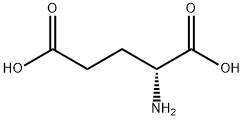
| Chemical Properties | White cryst. powder | | Uses | D-Glutamic Acid is the unnatural (R)-enantiomer of Glutamic Acid, a non-essential amino acid. Its salt form (glutamate) is an important neurotransmitter that plays a key role in long-term potentiation
and is important for learning and memory. Glutamic Acid is also a key molecule in cellular metabolism. | | Uses | D-Glutamic acid acts as a superior to alpha ketoglutarate. It helps in the growth of Lactobacillus arabinosus. It can inhibit the IgE binding to peanut allergens. It is widely used in pharmaceuticals and foods. | | Uses | D-glutamic acid is suitable for use in the structure-affinity relationship (SAR)-study of GR (glutamate racemase) enzyme and its inhibitors. | | Definition | ChEBI: An optically active form of glutamic acid having D-configuration. | | General Description | D-Glutamic acid is an essential constituent of the bacterial peptidoglycan structure. It is added to UDP-N-acetylmuramyl-L-alanine (UDP-MurNAc-L-alanine) by the enzyme D-glutamic acid-adding enzyme (murD). This is, then, incorporated into the peptidoglycan precursor. Peptidoglycan makes up the cell walls of Gram-positive and -negative bacteria. The conversion of L-glutamate to D-glutamate by glutamate racemase (GR) enzyme is an essential step in the synthesis of peptidoglycan. | | Biological Activity | Excitatory amino acid acting at NMDA receptors; less active than the L-isomer. | | Biochem/physiol Actions | Unnatural isomer of glutamic acid. |
| D(-)-Glutamic acid Preparation Products And Raw materials |
|


 日本语
日本语 한국어
한국어 Français
 Deutsch
 España
 Türkiye