Other grades of this product :
| ACIVICIN Basic information |
| ACIVICIN Chemical Properties |
| Melting point | >200°C (dec.) | | Boiling point | 341.6±48.0 °C(Predicted) | | density | 1.85±0.1 g/cm3(Predicted) | | storage temp. | 2-8°C | | solubility | H2O: soluble10mg/mL (warmed) | | pka | 2.02±0.10(Predicted) | | form | White solid. | | color | white to beige | | Water Solubility | Soluble in water at 10mg/ml with warming | | Stability: | Hygroscopic |
| Hazard Codes | Xn | | Risk Statements | 20/21/22 | | Safety Statements | 36 | | RIDADR | 3172 | | WGK Germany | 3 | | RTECS | NY2103000 | | HazardClass | 6.1(b) | | PackingGroup | III |
| ACIVICIN Usage And Synthesis |
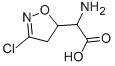
| Chemical Properties | Off-White Solid | | Originator | Acivicin ,ZYF Pharm Chemical | | Uses | Inhibits glutamine amidotransferases in purine and pyrimidine synthetic pathways. Tumor growth inhibitor | | Uses | Azaserine and Acivicin are classical and irreversible inhibitors of γ-Glutamyltranspeptidase | | Definition | ChEBI: An L-alpha-amino acid that is L-alanine in which the methyl group is replaced by a (5S)-3-chloro-4,5-dihydro-1,2-oxazol-5-yl group. A glutamine analogue antimetabolite, it interferes with
lutamate metabolism and several glutamate-dependent synthetic enzymes. It is obtained as a fermentation product of Streptomyces sviceus bacteria. | | Manufacturing Process | Starting from commercial, cis-2-buten-1,4-diol, the monotrichloroacetimidate
was obtained as a colorless liquid (60%, b.p. 88°-102°C/0.2 mm Hg) by
treatment with trichloroacetonitrile (1 equivalent) in tetrahydrofuran at -23°C
in the presence of catalytic amount of sodium. Monotrichloroacetimidate upon
refluxing in tert-butyl benzene for about 1 hour underwent, smoothly,rearrangement to afford the vinylglycine synton (84%, MP: 30°C). The
treatment of the last compound with bromonitrile oxide (3 equiv.) generated
in situ from dibromoformaldoxime in ethyl acetate containing excess of KHCO3
and trace amounts of water afforded 3:2 mixture of cycloadducts threo- and
erythro-N-[1-(3-bromo-4,5-dihydroisoxazol-5-yl)-2-hydroxyethyl]-2,2,2-
trichloroacetamide. The undesired threo- isomer (MP: 164°-165°C) was
quantitatively removed from the mixture by fractional crystallization from
chloroform. The erythro-isomer (oil) was refluxed with methanolic-HCl for 1
hour to give the chloro-alchohol (50%, syrup), which upon Jones oxidation
(with H2Cr2O7/acetone) followed by deprotection of trichloroacetyl group
(Ba(OH)2/H2O, H3+O) afforded racemic acivicin (66 %). The synthetic, racemic
antibiotic was spectrally (UV, 1H NMR) indistinguishable from | | Therapeutic Function | Antineoplastic | | Enzyme inhibitor | This cytotoxic isoxazole and copper chelator (FW = 178.57 g/mol; CAS 42228-92-2; Source: Streptomyces sviceus), also known as L-(aS,5S)-aamino-3-chloro-4,5-dihydro-5-isoxazoleacetic acid, AT-125, and NSC165301, strongly inhibitsγ-glutamyl transpeptidase. Its clinical application in cancer treatment failed as a consequence of unacceptable toxicity, and the cause(s) of the desired and undesired biological effects have never been elucidated and only limited information about acivicin-specific targets is available. Target deconvolution by quantitative mass spectrometry (MS) has now revealed acivicin’s preference for the specific aldehyde dehydrogenase known as ALDH4A1 by binding to the catalytic site. Moreover, siRNA-mediated downregulation of ALDH4A1 results in a severe inhibition of cell growth, a finding that may explain acivicin’s cytotoxicity. Targets: Acivicin is thought to be a glutamine analogue, an assumption that is amply supported by its ability to inhibit the following enzymes that possess essential amidohydrolase activities that generate nascent ammonia: asparagine synthetase; carbamoyl-phosphate synthetase; anthranilate synthase; glutamate synthase; CTP symthetase; amidophospho-ribosyltransferase; glutamin(asparagin)ase, or glutaminase-asparaginase; GMP synthase, glutamine-dependent; phosphoribosyl-formylglycinamidine synthetase (formylglycinamidine ribonucleotide synthetase; thiol oxidase; γ-glutamyl hydrolase; imidazole-glycerol phosphate synthetase. |
| ACIVICIN Preparation Products And Raw materials |
|


 日本语
日本语 한국어
한국어 Français
 Deutsch
 España
 Türkiye