Other grades of this product :
| Ethyl phenylacetate Basic information |
| Ethyl phenylacetate Chemical Properties |
| Safety Statements | 23-24/25 | | WGK Germany | 2 | | RTECS | AJ2824000 | | TSCA | Yes | | HS Code | 29163500 | | Hazardous Substances Data | 101-97-3(Hazardous Substances Data) | | toxicity | The acute oral LD50 value in rats was reported as 3.30g/kg(2.52-4.08 g/kg) (Moreno,1973).The acute dermal LD50 in rabbits was reported as > 5g/kg(Moreno, 1973). |
| Ethyl phenylacetate Usage And Synthesis |
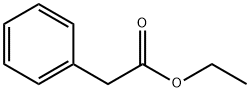
| Chemical Properties | Ethyl Phenylacetate is a volatile aroma component of fruit and honey. It is a clear colourless to pale yellowish liquid with a pleasant, strong, sweet odor reminiscent of honey and a bittersweet flavor. Small amounts are used in flower perfumes and in fruit flavors. | | Occurrence | Reported found in grapefruit juice, apple juice, figs, guava, pineapple, papaya, cognac, cider, grape wines and
port wine.
| | Uses | Ethyl phenylacetate was used to study the solvent-based self-healing of epoxy materials. It is also used as a flavoring agent, flavor animal feeds, In perfumery. | | Definition | ChEBI: Ethyl phenylacetate is a member of benzenes. It is a less toxic, greener solvent. It is non-mutagenic. | | Preparation | Ethyl phenylacetate is prepared by heating at the boil phenylacetonitrile and sulfuric acid in alcohol solution; by esterification of the acid catalyzed by HCl or H2SO4. | | Aroma threshold values | Detection: 650 ppb | | Taste threshold values | Taste characteristics at 10 ppm: sweet, fruity, honey, cocoa, apple and woody | | General Description | Ethyl phenylacetate is a less toxic, greener solvent. It is non-mutagenic. | | Flammability and Explosibility | Nonflammable | | Biochem/physiol Actions | Taste at 5 to 10 ppm | | Safety Profile | Moderately toxic by
ingestion. Combustible liquid. Mutation data
reported. When heated to decomposition it
emits acrid smoke and irritating fumes. See
also ESTERS. | | Purification Methods | Shake the ester with saturated aqueous Na2CO3 (three times), aqueous 50% CaCl2 (twice) and saturated aqueous NaCl (twice). Dry with CaCl2 and distil it under reduced pressure. [Beilstein 9 H 434, 9 IV 1618.] |
| Ethyl phenylacetate Preparation Products And Raw materials |
|


 日本语
日本语 한국어
한국어 Français
 Deutsch
 España
 Türkiye