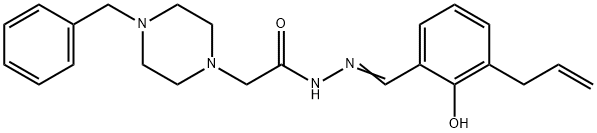
| PAC1 Basic information |
| Product Name: | PAC1 |
| Synonyms: | PAC1;4-(Phenylmethyl)-1-piperazineaceticacid[[2-hydroxy-3-(2-propenyl)phenyl]methylene]hydrazide;PAC1,4-(PhenylMethyl)-1-piperazineaceticacid[[2-hydroxy-3-(2-propenyl)phenyl]Methylene]hydrazide;4-(Phenylmethyl)-1-piperazineacetic acid 2-[[2-hydroxy-3-(2-propen-1-yl)phenyl]methylene]hydrazide;PAC-1,PAC1;Procaspase activating coMpound 1;(E)-N'-(3-allyl-2-hydroxybenzylidene)-2-(4-benzylpiperazin-1-yl)acetohydrazide;4-(Phenylmethyl)-1-piperazineacetic acid 2-[[2-hydroxy-3-(2-propen-1-yl)phenyl]methylene]hydrazide PAC-1 |
| CAS: | 315183-21-2 |
| MF: | C23H28N4O2 |
| MW: | 392.49 |
| EINECS: | |
| Product Categories: | Inhibitor;Inhibitors |
| Mol File: | 315183-21-2.mol |
| PAC1 Chemical Properties |
| density | 1.14 |
| storage temp. | Store at +4°C |
| solubility | DMSO: ≥10mg/mL |
| form | solid |
| pka | 8.82±0.40(Predicted) |
| color | white |
| Stability: | Stable for 1 year from date of purchase as supplied. Solutions in DMSO or ethanol must be stored under inert gas at -80°C and will be stable for up to 2 months. |
| Safety Information |
| Hazard Codes | Xn,N |
| Risk Statements | 22-36/37/38-50/53 |
| Safety Statements | 26-36/37-60-61 |
| RIDADR | UN 3077 |
| WGK Germany | 3 |
| HS Code | 29335990 |
| MSDS Information |
| PAC1 Usage And Synthesis |
| Description | PAC-1 (315183-21-2) is a procaspase-activating compound, directly activating procaspase-3, producing caspase-3, EC50=0.22 μM.1 It is less potent at activating procaspase-7, EC50=4.5 μM. It induces apoptosis in a variety of cancer cell lines. The mechanism of activation involves sequestering inhibitory zinc ions thus allowing procaspase-3 to autoactivate.2?? Sensitizes cancer cells to various chemotherapeutic agents.3 |
| Uses | PAC-1 is a potent procaspase-3 activator with EC50 of 0.22 μM. |
| Biological Activity | Procaspase-activating compound; activates procaspase-3 to produce caspase-3 (EC 50 = 0.22 μ M). Also activates procaspase-7 in a less efficient manner (EC 50 = 4.5 μ M). Pro-apoptotic; induces apoptosis in both cancerous and non-cancerous cells dependent on procaspase-3 concentration (IC 50 values are 0.003-1.41 and 5.02-9.98 μ M respectively). |
| References | 1) Putt et al. (2006), Small-molecule activation of procaspase-3 to caspase-3 as a personalized anticancer strategy; Nat. Chem. Biol., 2 543 2) Peterson et al. (2009), PAC-1 activates procaspase-3 in vitro through relief of zinc-mediated inhibition; J. Mol. Biol., 388 144 3) Bolham et al. (2016), Small-Molecule Procaspase-3 Activation Sensitizes Cancer to Treatment with diverse Chemotherapeutics; ACS Cent. Sci., 2 545 |
| PAC1 Preparation Products And Raw materials |
Please leave a message for us or use the following ways to contact us, we will reply to you as soon as possible, and provide you with the most sincere service, thank you.


 日本语
日本语 한국어
한국어 Français
 Deutsch
 España
 Türkiye