Other grades of this product :
| Tyramine Basic information |
| Tyramine Chemical Properties |
| Melting point | 160-162 °C(lit.) | | Boiling point | 175-181 °C8 mm Hg(lit.) | | density | 1.0630 (rough estimate) | | refractive index | 1.5849 (estimate) | | FEMA | 4215 | TYRAMINE | | Fp | 165°C | | storage temp. | 2-8°C | | solubility | DMSO (Slightly), Methanol (Slightly) | | form | Liquid | | pka | 9.74(at 25℃) | | color | Clear yellow to orange to slightly brown, may darken on storage | | Water Solubility | 1g/95mL (15 ºC) | | Merck | 14,9835 | | JECFA Number | 1590 | | BRN | 1099914 | | Stability: | Stable. Incompatible with strong acids, strong oxidizing agents. | | CAS DataBase Reference | 51-67-2(CAS DataBase Reference) | | NIST Chemistry Reference | Phenol, 4-(2-aminoethyl)-(51-67-2) | | EPA Substance Registry System | Tyramine (51-67-2) |
| Tyramine Usage And Synthesis |
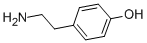
| Description | A decarboxylation product of tyrosine found in various fermentation products, including cheeses and some wines.
It causes sympathomimetic effects by acting as an indirect agonist, causing the release of endogenous catecholamines.
Because it is metabolized principally by monoamine oxidase,
patients taking monoamine oxidase inhibitors may have a
hypertensive crisis if they ingest foods containing significant
amounts of tyramine. | | Chemical Properties | white to light beige solid | | Chemical Properties | Colorless to yellow solid; sweet meaty aroma. | | Occurrence | Reported found in sauerkraut and soy sauce. | | Uses | adrenergic agonist, vasoconstrictor | | Uses | tyramine is uses as pharmaceutical intermediates. | | Uses | Clinical studies indicate that tyramine has skin-lightening capacities. | | Definition | ChEBI: A primary amino compound obtained by formal decarboxylation of the amino acid tyrosine. | | Aroma threshold values | Medium strength odor, meaty type; recommend smelling in a 5.00% solution or less. | | Taste threshold values | Mild, sweet, vegetative phenolic taste at 100 ppm in water. | | Synthesis | Tyramine, 4-(2-aminoethyl)phenol (11.2.1), can be synthesized in various
ways, in particular by the decarboxylation of tyrosine [46–48]. It is also isolated from the
tissues of livestock. | | Purification Methods | Crystallise tyramine from *benzene or EtOH. [Beilstein 13 IV 1788.] |
| Tyramine Preparation Products And Raw materials |
|


 日本语
日本语 한국어
한국어 Français
 Deutsch
 España
 Türkiye