Other grades of this product :
| Disodium edetate dihydrate Basic information |
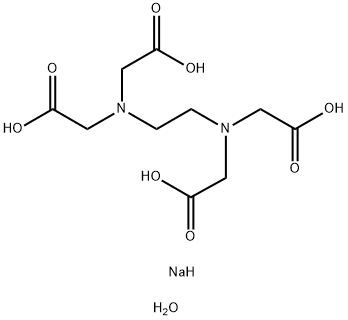
| Product Name: | Disodium edetate dihydrate | | Synonyms: | aceticacid,(ethylenedinitrilo)tetra-,disodiumsalt,dihydrate;disodiumedtadihydrate;ethylenediaminetetraaceticacidsodiumsaltdihydrate(disodiumedta;ethylenediaminetetraaceticacidsodiumsaltdihydrate(disodiumedtadihydrate);glycine,n,n’-1,2-ethanediylbis(n-(carboxymethyl)-,disodiumsalt,dihydrate;Glycine,N,N’-1,2-ethanediylbis[N-(carboxymethyl)-,disodiumsalt,dihydrate;1,2-DIAMINOETHANE-N,N,N',N'-TETRA-ACETIC ACID;EDTA TITRANT | | CAS: | 6381-92-6 | | MF: | C10H19N2NaO9 | | MW: | 334.26 | | EINECS: | 613-386-6 | | Product Categories: | Cosmetic or Industrial Grade;organic amine;Analytical Chemistry;Organic Chemicals;reagent;Food Additives;Chelating Reagents;Complexones;EDTA Analogs | | Mol File: | 6381-92-6.mol |
| Disodium edetate dihydrate Chemical Properties |
| Disodium edetate dihydrate Usage And Synthesis |
| Chemical Properties | White or almost white, crystalline powder. | | Uses | Chelating agent; sequestering agent | | Uses | Ethylenediamine tetraacetic acid disodium dihydrate is used as chelating agent for metals and as pharmaceutic aid (chelating agent); as preservative in cosmetic products; anticoagulant. | | Uses | Ethylenediaminetetraacetic acid disodium salt dihydrate is used as a chelator of divalent cations. It inhibits enzymes such as metalloproteases that require divalent cations for activity. It is also used in chelation therapy. It acts as a sequestering agent in shampoos, cleaners and other personal care products and serves as an anticoagulant for blood samples. | | Definition | ChEBI: A hydrate that is the dihydrate form of EDTA disodium salt. | | General Description | Ethylenediaminetetraacetic acid disodium salt dehydrate is designated as Molecular Biology grade and is suitable for molecular biology applications. It has been analyzed for the presence of nucleases and proteases. | | Biochem/physiol Actions | Zinc-dependent metalloproteinases, as well as other proteases that are stabilized by calcium, can be effectively inhibited by chelation of divalent metal ions with EDTA. Other chelators such as EGTA, specific for calcium, and 1,10-phenanthroline, highly specific for zinc, can be used to target these two different types of proteases. | | Purification Methods | Analytical reagent grade material can be used as primary standard after drying at 80o. Commercial grade material can be purified by crystallisation from water or by preparing a 10% aqueous solution at room temperature, then adding ethanol slowly until a slight permanent precipitate is formed, filtering, and adding an equal volume of ethanol. The precipitate is filtered off onto a sintered-glass funnel, is washed with acetone, followed by diethyl ether, and dried in air overnight to give the dihydrate. Drying at 80o for at least 24hours converts it to the anhydrous form. [Beilstein 4 IV 2451.] |
| Disodium edetate dihydrate Preparation Products And Raw materials |
|


 日本语
日本语 한국어
한국어 Français
 Deutsch
 España
 Türkiye