| Description | In an effort to develop angina agents without the unwanted negative
inotropic and hypotensive effects associated with b-adrenergic blockers and
calcium channel blockers, a new class of heart-rate reducing compounds that act
specifically on the sinoatrial (SA) node has been explored. These bradycardic
agents interact directly with the pacemaking cell of the SA node and the hyperpolarization-
activated If , the primary pacemaking current. Ivabradine has
evolved as a specific inhibitor of If current through its contact with f-channels on
the intracellular side of the plasma membrane. As a consequence, ivabradine
reduces the speed of diastolic depolarization and decreases heart rate. It has been
approved for the treatment of chronic stable angina and provides a viable
alternative to patients with a contraindication or intolerance of b-blockers. Evaluation
is also underway for the potential treatment of ischemic heart disease.
Using a patch-clamp technique on rabbit sinoatrial node cells, inhibition of If
current ranged from 6% (0.03 mM) – 80% (10 mM).
. |
| Chemical Properties | White to Off-White Solid |
| Originator | Servier (France) |
| Uses | Ivabradine hydrochloride has been used as a potassium/sodium hyperpolarization-activated cyclic nucleotide-gated channel (HCN)2 blocker in embryoid body (EB) and rat engineered heart tissue (EHT). |
| Uses | Ivabradine HCl, a new If inhibitor with IC 50 of 2.9 μM which acts specifically on the pacemaker activity of the sinoatrial node, is a pure heart rate lowering agent |
| Uses | angina therapeutic |
| Uses | Selective bradycardic agent with direct effect on the pacemaker If current of the sinoatrial node. Antianginal |
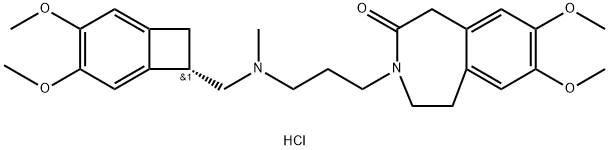
| Definition | ChEBI: A hydrochloride obtained by combining ivabradine with one molar equivalent of hydrochloric acid. Used to treat patients with angina who have intolerance to beta blockers and/or heart failure. |
| Brand name | Procoralan |
| Biochem/physiol Actions | Ivabradine is used to treat chronic heart failure. |
| Clinical Use | Symptomatic treatment of chronic stable angina pectoris
in patients with sinus rhythm
Treatment of mild to severe chronic heart failure |
| Drug interactions | Potentially hazardous interactions with other drugs
Anti-arrhythmics: increased risk of ventricular
arrhythmias with amiodarone and disopyramide.
Antibacterials: concentration possibly increased by
clarithromycin and telithromycin - avoid; increased
risk of ventricular arrhythmias with erythromycin -
avoid.
Antifungals: concentration increased by ketoconazole
- avoid; concentration increased by fluconazole -
reduce initial ivabradine dose; concentration possibly
increased by itraconazole - avoid.
Antimalarials: increased risk of ventricular
arrhythmias with mefloquine.
Antipsychotics: increased risk of ventricular
arrhythmias with pimozide.
Antivirals: concentration possibly increased by
ritonavir - avoid.
Beta-blockers: increased risk of ventricular
arrhythmias with sotalol.
Calcium-channel blockers: concentration increased
by diltiazem and verapamil - avoid.
Grapefruit juice: ivabradine concentration increased.
Pentamidine: increased risk of ventricular
arrhythmias.
St John’s wort: ivabradine concentration reduced -
avoid. |
| Metabolism | Ivabradine is extensively metabolised by the liver
and the gut by oxidation through cytochrome P450
3A4 (CYP3A4) only. The major active metabolite is
N-desmethyl-ivabradine (S 18982) with an exposure
about 40% of that of the parent compound. This active
metabolite undergoes further metabolism by CYP3A4.
Excretion of metabolites occurs to a similar extent via
faeces and urine. |


 日本语
日本语 한국어
한국어 Français
 Deutsch
 España
 Türkiye