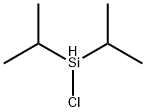
| DIISOPROPYLCHLOROSILANE Basic information |
| Product Name: | DIISOPROPYLCHLOROSILANE |
| Synonyms: | chloro(2,3-dimethylbutan-2-yl)silicon;Silane, chlorobis(1-methylethyl)-;CHLORODIISOPROPYLSILANE;DIISOPROPYLCHLOROSILANE;Diisopropylsilyl chloride;chloro-di(propan-2-yl)silicon;Chlorodiisopropylsilane >chlorobis(propan-2-yl)silane |
| CAS: | 2227-29-4 |
| MF: | C6H15ClSi |
| MW: | 150.72 |
| EINECS: | |
| Product Categories: | Pharmaceutical Intermediates;Monochlorosilanes;Reduction;Si (Classes of Silicon Compounds);Si-Cl Compounds;Si-H Compounds;Silicon Compounds (for Synthesis);Synthetic Organic Chemistry |
| Mol File: | 2227-29-4.mol |
| DIISOPROPYLCHLOROSILANE Chemical Properties |
| Boiling point | 58-60 °C50 mm Hg(lit.) |
| density | 0.883 g/mL at 25 °C(lit.) |
| refractive index | n |
| Fp | 72 °F |
| storage temp. | Inert atmosphere,Room Temperature |
| solubility | generally sol organic solvents; reacts with alcohols, ammonia,and water. |
| form | clear liquid |
| color | Colorless to Almost colorless |
| Specific Gravity | 0.883 |
| Hydrolytic Sensitivity | 8: reacts rapidly with moisture, water, protic solvents |
| BRN | 2231355 |
| CAS DataBase Reference | 2227-29-4(CAS DataBase Reference) |
| EPA Substance Registry System | Silane, chlorobis(1-methylethyl)- (2227-29-4) |
| Safety Information |
| Hazard Codes | C |
| Risk Statements | 10-34 |
| Safety Statements | 26-36/37/39-45 |
| RIDADR | UN 2986 8/PG 2 |
| WGK Germany | 3 |
| F | 10-21 |
| TSCA | Yes |
| HazardClass | 3.1 |
| PackingGroup | II |
| HS Code | 29319090 |
| MSDS Information |
| Provider | Language |
|---|---|
| SigmaAldrich | English |
| DIISOPROPYLCHLOROSILANE Usage And Synthesis |
| Physical properties | bp 150–153°C,bp 54–55°C/45 mmHg; d 0.872 gmL?1 |
| Uses | Intramolecular hydrosilylation is also possible within β-diisopropylsilyloxy esters (13), constituting an exceptionally mild method for reducing ester groups to the aldehyde oxidation level (eq 4).The derivatives (13) may be synthesized from β-hydroxy esters (12) as described above for the analogous ketones. Treatment with fluoride ions (but not Lewis acids) induces hydride transfer to give alkoxysiladioxanes (14) in excellent yields (≥95%). Although usually performed in dichloromethane, the hydrosilylation may also be accomplished with ethyl acetate as solvent, providing strong evidence for intramolecularity. |
| Application | Used in a silylation-reduction-allylation sequence of β-hydroxy esters to homoallylic-substituted 1,3-diols. Used in the silylation-hydrosilation-oxidation of allyl alcohols to 1,3-diols. Reaction carried out in diastereoselective manner. Reduces β-hydroxy ketones to anti-1,3 diols. |
| Preparation | obtained by reaction of trichlorosilane with isopropylmagnesium chloride;the original yield of 45% may be raised to 70–80% by employing conc hydrochloric acid to quench the reaction. |
| Purification Methods | Impurities can be readily detected by 1H NMR. Purify it by fractional distillation [Gilman & Clark J Am Chem Soc 69 1499 1947, Allen et al. J Chem Soc 3668 1957]. |
| DIISOPROPYLCHLOROSILANE Preparation Products And Raw materials |
| Raw materials | DIISOPROPYLSILANE-->ISOPROPYLMAGNESIUM BROMIDE-->2-Chloropropane-->ISOPROPYLMAGNESIUM CHLORIDE |
Please leave a message for us or use the following ways to contact us, we will reply to you as soon as possible, and provide you with the most sincere service, thank you.


 日本语
日本语 한국어
한국어 Français
 Deutsch
 España
 Türkiye