Other grades of this product :
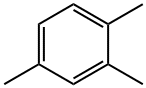
| Product Name: | 1,2,4-Trimethylbenzene | | Synonyms: | TRIMETHYLBENZENE;1,2,4-trimethyl-benzen;1,2,4-trimethylbenzene (pseudocumene);1,3,4-TRIMETHYLBENZENE;1,2,4-TRIMETHYLBENZENE;PSI-CUMENE;PSEUDOCUMENE;PSEUDOCUMOL | | CAS: | 95-63-6 | | MF: | C9H12 | | MW: | 120.19 | | EINECS: | 202-436-9 | | Product Categories: | Industrial/Fine Chemicals;Arenes;Alpha Sort;Building Blocks;Chemical Synthesis;Organic Building Blocks;Analytical Chemistry;Analytical Standards;AromaticsChemical Class;Chemical Class;Hydrocarbons;NeatsVolatiles/ Semivolatiles;TP - TZ;T-ZAlphabetic;Standard Solution of Volatile Organic Compounds for Water & Soil Analysis;Standard Solutions (VOC) | | Mol File: | 95-63-6.mol |
| 1,2,4-Trimethylbenzene Chemical Properties |
| Melting point | -44 °C | | Boiling point | 168 °C(lit.) | | density | 0.876 g/mL at 20 °C(lit.) | | vapor density | 4.1 (vs air) | | vapor pressure | 4.5 mm Hg ( 37.7 °C) | | refractive index | n20/D 1.504(lit.) | | Fp | 120 °F | | storage temp. | Store below +30°C. | | solubility | 0.057g/l | | form | Liquid | | pka | >14 (Schwarzenbach et al., 1993) | | color | Clear colorless | | explosive limit | 0.8-7%(V) | | Odor Threshold | 0.12ppm | | Water Solubility | Soluble in alcohol, benzene and ether. Slightly soluble in water | | Merck | 14,7915 | | BRN | 1903005 | | Henry's Law Constant | 6.946, 11.202, and 15.702 at 27.0, 35.0, and 45.0 °C, respectively (dynamic headspace, Hansen et al., 1995) | | Exposure limits | NIOSH REL: TWA 25 ppm (125 mg/m3); ACGIH TLV: TWA for mixed
isomers 25 ppm (adopted). | | Stability: | Stable. Incompatible with strong oxidizing agents. Flammable. May form explosive mixtures with air. | | InChIKey | GWHJZXXIDMPWGX-UHFFFAOYSA-N | | CAS DataBase Reference | 95-63-6(CAS DataBase Reference) | | EPA Substance Registry System | 1,2,4-Trimethylbenzene (95-63-6) |
| 1,2,4-Trimethylbenzene Usage And Synthesis |
| Description | 1,2,4-Trimethylbenzene (mesitylene) is an aromatic hydrocarbon compound commonly present in commercial solvents encompassing their boiling range. Mesitylene are the most common isomer used in commercial applications. Aromatic hydrocarbons in hydrocarbon solvents are predominantly alkylated one ring structures as well as two aromatic ring structures which may also be alkylated.
| | Toxicity | Acute toxicity studies (oral, dermal and inhalation routes of exposure) have been conducted in rats. Oral LD50 values of greater than 5000 mg/kg have been reported. For solvent products containing predominantly mixed C9 aromatic hydrocarbons, oral LD50 values have been reported as greater than 6880 mg/kg (males) and greater than 3440 mg/kg (females). LC50 values of 18,000 mg/m3 was reported for 1,2,4-TMB. For C9 aromatic solvents, the LC50 was greater than 10,200 mg/m3 (Shell Research Laboratory, 1976, unpublished study). One dermal acute study showed an LD50 value of greater than 3440 mg/kg for a C9 aromatic solvent (Shellsol A, a highly aromatic solvent boiling in the white spirit range, consisting of primarily C9 isomers particularly TMBs)
| | Chemical Properties | colourless liquid | | Physical properties | Colorless liquid with a slight aromatic odor. A detection odor threshold concentration of 12 mg/m3
(2.4 ppmv) was experimentally determined by Dravnieks (1974). | | Uses | 1,2,4-Trimethylbenzene is the unlabelled version of 1,2,4-Trimethyl 13C6-benzene (T796173), a labelled aromatic standard. | | Uses | Sterilizing catgut by heating one hour at 160°; solvent in manufacture of dyes, perfumes and resins. Solvent for liquid scintillation counting solutions. | | Definition | ChEBI: A trimethylbenzene carrying methyl groups at positions 1, 2 and 4. | | Synthesis Reference(s) | Journal of the American Chemical Society, 73, p. 766, 1951 DOI: 10.1021/ja01146a079Chemical and Pharmaceutical Bulletin, 34, p. 540, 1986 DOI: 10.1248/cpb.34.540 | | General Description | A liquid. Flash point near 130°F. Less dense than water and insoluble in water. Vapors irritate eyes, throat, and nose. Used in dyes and pharmaceuticals. | | Air & Water Reactions | Insoluble in water. | | Reactivity Profile | 1,2,4-Trimethylbenzene is incompatible with the following: Oxidizers, nitric acid . | | Hazard | Moderate fire risk. Central nervous system
depressant, irritant to mucous membranes. Asthma
and hematologic effects.
| | Health Hazard | Harmful if inhaled or swallowed. Vapor or mist is irritating to the eyes, mucous membrane and upper respiratory tract. Prolonged contact can cause dermatitis, nausea, headache, dizziness, and narcotic effect. | | Safety Profile | Moderately toxic by
intraperitoneal route. Mildly toxic by
inhalation. Can cause central nervous system
depression, anemia, bronchitis. Flammable
liquid when exposed to heat, sparks, or
flame. To fight fire, use foam, alcohol foam,
mist. Emitted from modern building
materials (CENEAR 69,22,91). When
heated to decomposition it emits acrid
smoke and irritating fumes. | | Source | Detected in distilled water-soluble fractions of 87 octane gasoline (1.11 mg/L), 94 octane
gasoline (3.11 mg/L), Gasohol (2.90 mg/L), No. 2 fuel oil (0.51 mg/L), jet fuel A (0.44 mg/L),
diesel fuel (0.39 mg/L), and military jet fuel JP-4 (0.39 mg/L) (Potter, 1996). Schauer et al. (1999)
reported 1,2,4-trimethylbenzene in a diesel-powered medium-duty truck exhaust at an emission
rate of 880 μg/km.
California Phase II reformulated gasoline contained 1,2,4-trimethylbenzene at a concentration of
24.6 g/kg. Gas-phase tailpipe emission rates from gasoline-powered automobiles with and without
catalytic converters were 5.72 and 602 mg/km, respectively (Schauer et al., 2002).
Thomas and Delfino (1991) equilibrated contaminant-free groundwater collected from
Gainesville, FL with individual fractions of three individual petroleum products at 24–25 °C for
24 h. The aqueous phase was analyzed for organic compounds via U.S. EPA approved test method
602. Average 1,2,4-trimethylbenzene concentrations reported in water-soluble fractions of
unleaded gasoline, kerosene, and diesel fuel were 1.952, 0.478, and 0.130 mg/L, respectively.
When the authors analyzed the aqueous-phase via U.S. EPA approved test method 610, average
1,2,4-trimethylbenzene concentrations in water-soluble fractions of unleaded gasoline, kerosene,
and diesel fuel were generally greater, i.e., 1.968, 0.401, and 0.146 mg/L, respectively.
Drinking water standard: No MCLGs or MCLs have been proposed (U.S. EPA, 2000). | | Environmental fate | Biological. In anoxic groundwater near Bemidji, MI, 1,2,4-trimethylbenzene anaerobically
biodegraded to the intermediate 3,4-dimethylbenzoic acid and the tentatively identified
compounds 2,4- and/or 2,5-dimethylbenzoic acid (Cozzarelli et al., 1990).
Photolytic. Glyoxal, methylglyoxal, and biacetyl were produced from the photooxidation of
1,2,4-trimethylbenzene by OH radicals in air at 25 °C (Tuazon et al., 1986a). A rate constant of
2.0 x 10⁻⁸ L/molecule?sec was reported for the reaction of 1,2,4-trimethylbenzene with OH radicals
in the gas phase (Darnall et al., 1976). Similarly, the rate constants for the reaction of 1,2,4-
trimethylbenzene and OH radicals at room temperature were 3.35 x 10⁻¹¹ (Hansen et al., 1975) and
3.84 x 10⁻¹¹ cm3/molecule?sec (Atkinson, 1985). At 25 °C, a rate constant of 3.15 x 10⁻¹¹
cm3/molecule?sec was reported for the same reaction (Ohta and Ohyama, 1985). Products
identified from the OH radical-initiated reaction of 1,2,4-trimethylbenzene in the presence of
nitrogen dioxide were 3-hexene-2,5-dione and 2,3-butanedione (Bethel et al., 2000).
Chemical/Physical. 1,2,4-Trimethylbenzene will not hydrolyze in water (Kollig, 1993). | | Purification Methods | Reflux pseudocumene over sodium and distil it under reduced pressure. [Beilstein 6 H 1088, 6 I 542, 6 II 1072, 6 III 6278, 6 IV 7339.] |
| 1,2,4-Trimethylbenzene Preparation Products And Raw materials |
| Raw materials | PETROLEUM ETHER-->1,2,3,4-Tetramethylbenzene-->1,2,3-Trimethylbenzene | | Preparation Products | Mesitylene-->Trimellitic Anhydride-->1-(4-Pyridyl)piperazine-->1,2,4,5-Tetramethylbenzene-->1,2,4-Benzenetricarboxylic acid-->Pyromellitic Dianhydride-->4-Hydroxy carbazole-->Trimethylhydroquinone-->TRIMETHYLQUINONE-->2,3,5-TRIMETHYL-1,4-BENZENE DIAMINE-->Chrysene-->PSEUDOCUMENE-5-SULFONIC ACID-->Pyromellitic acid-->2-Methyl-2-butene-->2,4,6-(TRIMETHYL)BENZYLCHLORIDE-->2,4,6-Collidine-->5-BROMO-1,2,4-TRIMETHYLBENZENE |
|


 日本语
日本语 한국어
한국어 Français
 Deutsch
 España
 Türkiye