Other grades of this product :
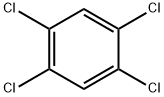
| 1,2,4,5-Tetrachlorobenzene Basic information |
| Product Name: | 1,2,4,5-Tetrachlorobenzene | | Synonyms: | I,2,4,5-Tetrachlorbenzol;Rcra waste number U207;rcrawastenumberu207;s-Tetrachlorobenzene;Melting point 140.0 to 143.0 deg-C;Purity(GC) min. 99.0 %;1,2,4,5-Tetrachlorobenzne;1,2,4,5-TETRACHLOROBENZENE, 1X1ML, ACN 1 000UG/ML | | CAS: | 95-94-3 | | MF: | C6H2Cl4 | | MW: | 215.89 | | EINECS: | 202-466-2 | | Product Categories: | Organics;Chlorine Compounds;Pesticides&Metabolites;Aryl;C6;Halogenated Hydrocarbons;Alpha Sort;TA - TE;T-ZAlphabetic;Volatiles/ Semivolatiles;Q-ZAlphabetic | | Mol File: | 95-94-3.mol |
| 1,2,4,5-Tetrachlorobenzene Chemical Properties |
| Melting point | 139 °C | | Boiling point | 240-246 °C(lit.) | | density | 1.858 | | vapor pressure | 5 at 25 °C (extrapolated, Mackay et al., 1982) | | refractive index | 1.5348 (estimate) | | Fp | >230 °F | | storage temp. | 0-6°C | | solubility | 0.0003g/l | | form | Crystalline Solid | | color | Light pink to gray | | Water Solubility | insoluble. <0.1 g/100 mL at 21 ºC | | BRN | 1618315 | | Henry's Law Constant | 0.10 at 20 °C (gas stripping-GC, Oliver, 1985) | | Stability: | Stable. Combustible. Incompatible with strong oxidizing agents. Reacts explosively with alkaline methanol solutions. | | CAS DataBase Reference | 95-94-3(CAS DataBase Reference) | | NIST Chemistry Reference | Benzene, 1,2,4,5-tetrachloro-(95-94-3) | | EPA Substance Registry System | 1,2,4,5-Tetrachlorobenzene (95-94-3) |
| 1,2,4,5-Tetrachlorobenzene Usage And Synthesis |
| Chemical Properties | white solid | | Uses | Intermediate for herbicides and defoliants,
insecticide, impregnant for moisture resistance,
electrical insulation. | | Uses | 1,2,4,5-Tetrachlorobenzene was used to study the environmental behavior of hexachlorobutadiene (HCBD). | | Definition | ChEBI: A tetrachlorobenzene carrying chloro groups at positions 1, 2, 4 and 5. | | Environmental fate | Biological. A mixed culture of soil bacteria or a Pseudomonas sp. transformed 1,2,4,5-
tetrachlorobenzene to 2,3,5,6-tetrachlorophenol (Ballschiter and Scholz, 1980). After incubation in
sewage sludge for 32 d under anaerobic conditions, 1,2,4,5-tetrachlorobenzene did not biodegrade
(Kirk et al., 1989).
In an enrichment culture derived from a contaminated site in Bayou d’Inde, LA, 1,2,4,5-
tetrachlorobenzene underwent reductive dechlorination to 1,2,4-trichlorobenzene. The maximum
dechlorination rate, based on the recommended Michaelis-Menten model, was 5.5 nM/d
(Pavlostathis and Prytula, 2000).
Photolytic. Irradiation (λ ≥285 nm) of 1,2,4,5-tetrachlorobenzene (1.1–1.2 mM/L) in an
acetonitrile-water mixture containing acetone (0.553 mM) as a sensitizer gave the following
products (% yield): 1,2,4-trichlorobenzene (25.3), 1,3-dichlorobenzene (8.1), 1,4-dichlorobenzene
(3.6), 2,2′,3,4′,5,5′,6-heptachlorobiphenyl (4.19), four hexachlorobiphenyls (6.78), four pentachlorobiphenyls
(2.33), one tetrachlorobiphenyl (0.32), 2,4,5-trichloroacetophenone, and (2,4,5-
trichlorophenyl)acetonitrile (Choudhry and Hutzinger, 1984). Without acetone, the identified
photolysis products (% yield) included 1,2,4-trichlorobenzene (27.7), 1,3-dichlorobenzene (0.3),
1,4-dichlorobenzene (8.5), pentachlorobenzene (trace), 1,2,3,4-tetrachlorobenzene (0.45), 1,2,3,5-
tetrachlorobenzene (1.11), 2,2′,3,4′,5,5′,6-heptahlorobiphenyl (1.24), three hexachlorobiphenyls
(1.19), and four pentachlorobiphenyls (0.56) (Choudhry and Hutzinger, 1984). The sunlight
irradiation of 1,2,4,5-tetrachlorobenzene (20 g) in a 100-mL borosilicate glass-stoppered Erlenmeyer flask for 28 d yielded 26 ppm heptachlorobiphenyl (Uyeta et al., 1976).
Chemical/Physical. Based on an assumed base-mediated 1% disappearance after 16 d at 85 °C
and pH 9.70 (pH 11.26 at °C), the hydrolysis half-life was estimated to be >900 yr (Ellington et
al., 1988). | | Purification Methods | Crystallise it from EtOH, ether, *benzene, *benzene/EtOH or carbon disulfide. [Beilstein 5 IV 668.] |
| 1,2,4,5-Tetrachlorobenzene Preparation Products And Raw materials |
| Raw materials | PENTACHLOROBENZENE-->1,2,3,5-Tetrachlorobenzene-->Benzene,1,4-dibromo-2,3,5,6-tetrachloro- | | Preparation Products | 2,4,5-Trichlorophenol-->2-(2,4,5-TRICHLOROPHENOXY)PROPIONIC ACID-->2,3,4,5,6-PENTAFLUOROPHENYLACETIC ACID-->2,4,5-Trichlorobenzoic acid-->1,2,4,5-TETRAKIS(TERT-BUTYLTHIO)BENZENE-->1,2,4,5-tetraphenylbenzene-->2,4,5-TRICHLOROBIPHENYL-->1,2,4,5-Benzenetetrathiol-->4H,4'H-OCTAFLUOROBIPHENYL-->2,3,5,6-TETRACHLOROPHENOL-->1,2,4-Triphenylbenzene |
|


 日本语
日本语 한국어
한국어 Français
 Deutsch
 España
 Türkiye