Other grades of this product :
| Isobutyric anhydride Basic information |
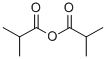
| Product Name: | Isobutyric anhydride | | Synonyms: | Isobutyric anhydride, distilled;#niso-Butyric anhydride;Bis(2-methylpropanoic)anhydride;Bis(2-methylpropionic)anhydride;Bis(isobutyric)anhydride;Di(isobutyric acid)anhydride;Diisobutyric anhydride;(iso-C3H7CO)2O | | CAS: | 97-72-3 | | MF: | C8H14O3 | | MW: | 158.2 | | EINECS: | 202-603-6 | | Product Categories: | Organics;1 | | Mol File: | 97-72-3.mol |
| Isobutyric anhydride Chemical Properties |
| Melting point | -56 °C (lit.) | | Boiling point | 182 °C (lit.) | | density | 0.954 g/mL at 25 °C (lit.) | | vapor density | 5.45 (vs air) | | vapor pressure | 10 mm Hg ( 67 °C) | | refractive index | n20/D 1.406(lit.) | | Fp | 152 °F | | storage temp. | Store below +30°C. | | form | Liquid | | color | Clear colorless | | explosive limit | 1.09%, 87°F | | Water Solubility | decomposes | | Sensitive | Moisture Sensitive | | BRN | 386267 | | Exposure limits | ACGIH: TWA 10 ppmNIOSH: TWA 10 ppm(30 mg/m3); STEL 15 ppm(45 mg/m3) | | LogP | 1.1 at 25℃ | | CAS DataBase Reference | 97-72-3(CAS DataBase Reference) | | NIST Chemistry Reference | Propanoic acid, 2-methyl-, anhydride(97-72-3) | | EPA Substance Registry System | Isobutyric anhydride (97-72-3) |
| Hazard Codes | C | | Risk Statements | 34-21/22 | | Safety Statements | 26-36/37/39-45 | | RIDADR | 2922 | | WGK Germany | 3 | | RTECS | NQ5550000 | | F | 13-21 | | Autoignition Temperature | 624 °F | | TSCA | Yes | | HS Code | 2915 90 70 | | HazardClass | 8 | | PackingGroup | II | | Hazardous Substances Data | 97-72-3(Hazardous Substances Data) | | Toxicity | LD50 orally in Rabbit: 266 mg/kg LD50 dermal Rabbit 475 mg/kg |
| Isobutyric anhydride Usage And Synthesis |
| Chemical Properties | clear colorless liquid | | Uses | Chemical intermediate. | | Uses | Isobutyric anhydride was used in the synthesis of 4-O-isobutyryl derivative via reaction with octyl β-D-glucopyranoside in the presence of C2-symmetric chiral 4-pyrrolidinopyridine as a catalyst. | | Definition | ChEBI: An acyclic carboxylic anhydride of isobutyric acid. Metabolite observed in cancer metabolism. | | General Description | A colorless liquid. Flash point 139°F. Burns skin and eyes. Vapors are heavier than air. | | Air & Water Reactions | Flammable. Reacts exothermically with water or moisture-containing materials to form isobutyric acid. | | Reactivity Profile | Isobutyric anhydride reacts exothermically with water. The reactions are sometimes slow, but can become violent when local heating accelerates their rate. Acids accelerate the reaction with water. Incompatible with a cids, strong oxidizing agents, alcohols, amines, and bases. | | Hazard | Strong irritant to tissue. | | Health Hazard | May cause toxic effects if inhaled or ingested/swallowed. Contact with substance may cause severe burns to skin and eyes. Fire will produce irritating, corrosive and/or toxic gases. Vapors may cause dizziness or suffocation. Runoff from fire control or dilution water may cause pollution. | | Fire Hazard | Flammable/combustible material. May be ignited by heat, sparks or flames. Vapors may form explosive mixtures with air. Vapors may travel to source of ignition and flash back. Most vapors are heavier than air. They will spread along ground and collect in low or confined areas (sewers, basements, tanks). Vapor explosion hazard indoors, outdoors or in sewers. Runoff to sewer may create fire or explosion hazard. Containers may explode when heated. Many liquids are lighter than water. |
| Isobutyric anhydride Preparation Products And Raw materials |
|


 日本语
日本语 한국어
한국어 Français
 Deutsch
 España
 Türkiye