Other grades of this product :
| CARBONYL CYANIDE 3-CHLOROPHENYLHYDRAZONE Basic information |
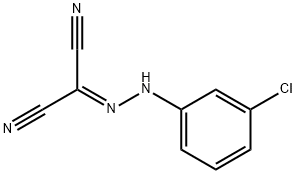
| Product Name: | CARBONYL CYANIDE 3-CHLOROPHENYLHYDRAZONE | | Synonyms: | (3-CHLOROPHENYL)HYDRAZONOMALONONITRILE;MESOXALONITRILE 3-CHLOROPHENYLHYDRAZONE;CCCP;[(3-chlorophenyl)hydrazono]-propanedinitril;m-chlorophenylcarbonylcyanidehydrazone;mesoxalonitrile,(m-chlorophenyl)hydrazone;M-CL-CCP;MESOXALONITRILE (3-CHLOROPHENYL)HYDRAZONE;BUTTPARK 91\04-41;CARBONYL CYANIDE M-CHLOROPHENYL-HYDRAZONE | | CAS: | 555-60-2 | | MF: | C9H5ClN4 | | MW: | 204.62 | | EINECS: | 209-103-7 | | Product Categories: | Caspases/Apoptosis | | Mol File: | 555-60-2.mol |
| CARBONYL CYANIDE 3-CHLOROPHENYLHYDRAZONE Chemical Properties |
| Melting point | 170-175 °C (dec.) | | Boiling point | 333.84°C (rough estimate) | | density | 1.3807 (rough estimate) | | refractive index | 1.6110 (estimate) | | storage temp. | -20°C | | solubility | methanol: 10 mg/mL, clear, very deep yellow | | form | powder | | pka | 6.00±0.10(Predicted) | | color | yellow to orange | | Water Solubility | Insoluble in water. Soluble in DMSO (5 mg/ml), ethanol (1 mg/ml) and methanol (10 mg/ml). | | BRN | 1842102 | | Exposure limits | NIOSH: IDLH 25 mg/m3 | | InChIKey | UGTJLJZQQFGTJD-UHFFFAOYSA-N | | CAS DataBase Reference | 555-60-2(CAS DataBase Reference) | | EPA Substance Registry System | Propanedinitrile, [(3-chlorophenyl)hydrazono]- (555-60-2) |
| Hazard Codes | T | | Risk Statements | 23/24/25-36/37/38 | | Safety Statements | 26-36/37-45 | | RIDADR | UN 2811 6.1/PG 3 | | WGK Germany | 3 | | RTECS | FG5600000 | | TSCA | Yes | | HazardClass | 6.1 | | PackingGroup | III | | HS Code | 29280090 |
| CARBONYL CYANIDE 3-CHLOROPHENYLHYDRAZONE Usage And Synthesis |
| Description | CCCP is a protonophore mitochondrial uncoupler that increases membrane permeability to protons, leading to a disruption in the mitochondrial membrane potential. It inhibits mitochondrial respiration and ATPase activity when used at concentrations of 110 and 35 nM, respectively. CCCP inhibits activation of stimulation of interferon genes (STING), decreasing the expression of downstream STING targets, including IFN-β, TBK1, and IRF3 when used at a concentration of 50 μM in RAW 264.7 cells. It induces mitochondrial fission in a manner dependent on the GTPase Drp1. CCCP (4 mg/kg) increases body temperature as well as left ventricular systolic and diastolic dimensions and decreases fractional shortening in rats. It also increases myocardial glucose and fatty acid uptake in rats. | | Chemical Properties | yellow to orange-brown crystalline powder | | Uses | Carbonyl cyanide 3-chlorophenylhydrazone is a widely used uncoupler of oxidative phosphorylation. | | Uses | Carbonyl cyanide 3-chlorophenylhydrazone (CCCP) has been used:- in the inhibition of efflux pump in clinical Pseudomonas aeruginosa
- to inhibit oxidative phosphorylation activity of mitochondria in human Beas-2B bronchial epithelial cells
- to prepare carbonyl cyanide m-chlorophenylhydrazone solution for oxidative and mitochondrial stress assay and mitophagy induction in Caenorhabditis elegans
| | Biological Activity | Widely used uncoupler of oxidative phosphorylation. | | Biochem/physiol Actions | Carbonyl cyanide 3-chlorophenylhydrazone (CCCP) induces mitophagy in mammalian cells. CCCP suppresses the expression of few electron transport chain (ETC) proteins. Protonophore (H+ ionophore) and uncoupler of oxidative phosphorylation in mitochondria. Shown to have a number of effects on cellular calcium. Inhibits secretion of hepatic lipase and partially inhibits the pH gradient-activated Cl- uptake and Cl-/Cl- exchange activities in brush-border membrane vesicles. | | in vitro | a genetic β-galactoside reporter system with a disk diffusion assay on macconkey lactose agar petri plates to monitor maintenance of the bacteriophage λ prophage state and viral induction in escherichia coli k-12. it presented evidence that the phage λ major lytic promoters, pl and pr, are activated via cells containing the reporters following exposure to the energy poison cccp. requirement of expression of the λ lytic promoters in response to cccp is host reca function and an auto-cleavable ci repressor, as does sos induction of the λ prophage occurring by a dna damage-dependent pathway. cccp-mediated activation of the λ lytic promoters required λ cro function. cccp does not modulate an sfi-lacz sos reporter [1]. the uncoupler cccp blocks oxidative phosphorylation by damaging the proton gradient. an anion cccp can bind a proton. but cccp with a delocalized negative charge allows it to cross the lipid bilayer in the unprotonated form, while weak acids cross the hydrophobic membrane only when protonated. many protons can be transported by one molecule of cccp across the inner membrane. it is described that a genetic reporter system to monitor maintenance of the λ prophage state and viral induction, and evidence is presented that it activates the major leftward and rightward lytic promoters of the λ prophage that cells are exposed to the energy poison cccp. | | references | [1]. thomason lc, court dl. evidence that bacteriophage λ lysogens may induce in response to the proton motive force uncoupler cccp. fems microbiol lett. 2016 feb;363(3). |
| CARBONYL CYANIDE 3-CHLOROPHENYLHYDRAZONE Preparation Products And Raw materials |
|


 日本语
日本语 한국어
한국어 Français
 Deutsch
 España
 Türkiye