Other grades of this product :
| MYCOPHENOLATE SODIUM Basic information |
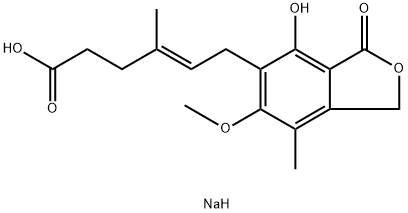
| Product Name: | MYCOPHENOLATE SODIUM | | Synonyms: | mycophenolicacidmonosodiumsalt;mycophenolicmonosodiumsalt;sodiummycophenolate;MYCOPHENOLATE SODIUM;4-Hexenoic acid,6-(1,3-dihydro-4-hydroxy-6-Methoxy-7-Methyl-3-oxo-5-isobenzofuranyl)-4-Methyl-,sodiuM salt;4-Hexenoic acid,6-(1,3-dihydro-4-hydroxy-6-Methoxy-7-Methyl-3-oxo-5-isobenzofuranyl)-4-Methyl-,sodiuM salt (1:1), (4E)-;(4E)-6-(4-Hydroxy-6-methoxy-7-methyl-3-oxo-1,3-dihydroisobenzofuran-5-yl)-4-methylhex-4-enoic acid sodium salt;Mycophenolate sodium CRS | | CAS: | 37415-62-6 | | MF: | C17H21NaO6 | | MW: | 344.34 | | EINECS: | | Product Categories: | | Mol File: | 37415-62-6.mol |
| MYCOPHENOLATE SODIUM Chemical Properties |
| HS Code | 2932202000 | | Toxicity | LD50 in mice (mg/kg): 1176±151 orally; 568±53 i.p. (Williams) |
| MYCOPHENOLATE SODIUM Usage And Synthesis |
| Description | Mycophenolate sodium, an immunosuppressive agent, was launched in
Switzerland as an oral treatment in combination with Neoral? and corticosteroids for
the prevention of acute transplant rejection in adult patients receiving allogeneic
renal transplantation. In contrast to the previously marketed product mycophenolate
mofetil (MMF, CellCept?), which is a prodrug and must be converted to
mycophenolic acid (MPA) in vivo, Myfortic? contains MPA itself as the active
ingredient. Myfortic? was designed to enhance the therapeutic efficacy of MPA
through increased tolerability relative to systemic exposure. Unlike MMF, which is
absorbed in the stomach, the enteric-coated formulation of MPA sodium is mainly
absorbed in the small intestine, thus protecting the upper GI tract from the side
effects of MPA. MPA is an inhibitor of inosine monophosphate dehydrogenase
(IMDPH), a vital enzyme in the de novo pathway of purine biosynthesis.
Proliferating lymphocytes rely principally on this pathway for purine production,thus rendering them succeptible to depletion of purine bases by MPA. Inhibition of
IMPDH by MPA results in the inhibition of both T- and B-lymphocyte proliferation
upon antigen challenge and facilitates the prevention of acute graft rejection.
Following oral administration of MPA sodium, the tmax of MPA is 1.5–2 h, with a
mean absolute bioavailability of 71% and a mean half-life of 11.7 h. MPA is
primarily metabolized in the liver by glucuronidation and excreted mainly in the
urine as the metabolite. The recommended dosage regimen of MPA sodium is
720 mg twice daily, which provides equimolar amounts of MPA compared
with MMF 1000 mg twice daily. In two major clinical trials in 748 patients,
Myfortic? was demonstrated to be a highly potent and well-tolerated immunosuppressant
for new renal transplant patients. A trend was seen towards fewer dose
reductions due to GI intolerability and less serious infections relative to other MPA
drugs. The most common adverse events associated with MPA treatment are
diarrhea and leukopenia. | | Originator | Novartis (Switzerland) | | Uses | Mycophenolic Acid Monosodium Salt in its enteric-coated form is used as an immunosuppressive agent in organ transplantation and autoimmune diseases.Environmental contaminants; Food contaminants | | Uses | Immunosuppressant | | Definition | ChEBI: An organic sodium salt that is the sodium salt of mycophenolic acid. An immunosuppressant, it is widely used to prevent tissue rejection following organ transplants and for the treatment of certain autoimmune diseases. | | Brand name | Myfortic | | Synthesis | Mycophenolic
acid (137) was originally synthesized by Birch and Wright
and has been the subject of several total and
formal syntheses. The large production in industry is
done via fermentation. A concise synthesis of
mycophenolic acid published recently is depicted in Scheme
17. Reaction of dimethyl 1,3-acetonedicarboxylate (128)
with commercially available geranyl chloride (129) in the
presence of NaH gave ketoester 130 in 82% yield. Treatment
of ketoester 130 with 4-(pivolyloxy)-2-butynal (131) in the
presence of NaH provided resorcinol 132 in a single step
with all substituents in place in 33% yield along with two
more compounds represented by 133 (62%). Resorcinol 132
was transformed into 134 via a four step sequences:
methylation with NaH and MeI in dry DMF, reduction of
the formyl group with NaBH4, mesylation of the resulting
alcohol and subsequent reduction of the mesylate. The
preparation of phthalide 135 was affected in quantitative
yield on treatment of 134 with K2CO3 in dry MeOH.
Selective ozonolysis of compound 135, followed by Jones
oxidation and esterification afforded ester 136.
Demethylation with BCl3 in DCM followed by hydrolysis
of the ester function gave the mycophenolic acid (137). The
mycophenolic acid was then converted to its sodium salt
XVII (no conditions and yield available). |
| MYCOPHENOLATE SODIUM Preparation Products And Raw materials |
|


 日本语
日本语 한국어
한국어 Français
 Deutsch
 España
 Türkiye