Other grades of this product :
| Dimethyl-N-propylamine Basic information |
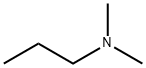
| Product Name: | Dimethyl-N-propylamine | | Synonyms: | 1-Propanamine, N,N-dimethyl-;1-Propanamine,N,N-dimethyl-;Dimethylpropylamin;N,N-Dimethyl-1-propanamine;Propylamine, N,N-dimethyl-;Propylamine,N,N-dimethyl-;Propyldimethylamine;DIMETHYLPROPYLAMINE | | CAS: | 926-63-6 | | MF: | C5H13N | | MW: | 87.16 | | EINECS: | 213-139-9 | | Product Categories: | | Mol File: | 926-63-6.mol |
| Dimethyl-N-propylamine Chemical Properties |
| Melting point | -115.88°C (estimate) | | Boiling point | 65.85°C | | density | 0.6955 | | vapor pressure | 17.25kPa at 20℃ | | refractive index | 1.3832 | | solubility | Completely miscible in water | | pka | 9.83±0.28(Predicted) | | form | clear liquid | | color | Colorless to Almost colorless | | Water Solubility | 1000g/L at 20℃ | | LogP | 1.32 at 23℃ | | NIST Chemistry Reference | (CH3)2(n-C3H7)N(926-63-6) | | EPA Substance Registry System | N,N-Dimethylpropylamine (926-63-6) |
| RIDADR | UN 2266 | | HazardClass | 3.1 | | PackingGroup | II |
| Dimethyl-N-propylamine Usage And Synthesis |
| General Description | A colorless liquid. Flash point near 10°F. Less dense than water. Contact may irritate skin, eyes and mucous membranes. May be toxic by ingestion. Used to make other chemicals. | | Air & Water Reactions | Highly flammable. Water soluble. | | Reactivity Profile | Dimethyl-N-propylamine neutralizes acids in exothermic reactions to form salts plus water. May be incompatible with isocyanates, halogenated organics, peroxides, phenols (acidic), epoxides, anhydrides, and acid halides. Flammable gaseous hydrogen may be generated in combination with strong reducing agents, such as hydrides. | | Health Hazard | May cause toxic effects if inhaled or ingested/swallowed. Contact with substance may cause severe burns to skin and eyes. Fire will produce irritating, corrosive and/or toxic gases. Vapors may cause dizziness or suffocation. Runoff from fire control or dilution water may cause pollution. | | Fire Hazard | Flammable/combustible material. May be ignited by heat, sparks or flames. Vapors may form explosive mixtures with air. Vapors may travel to source of ignition and flash back. Most vapors are heavier than air. They will spread along ground and collect in low or confined areas (sewers, basements, tanks). Vapor explosion hazard indoors, outdoors or in sewers. Runoff to sewer may create fire or explosion hazard. Containers may explode when heated. Many liquids are lighter than water. | | Flammability and Explosibility | Highlyflammable |
| Dimethyl-N-propylamine Preparation Products And Raw materials |
|


 日本语
日本语 한국어
한국어 Français
 Deutsch
 España
 Türkiye